›
Wholesale Lawn Mower Belts for Parts Distributors
Wholesale Lawn Mower Belts for Parts Distributors
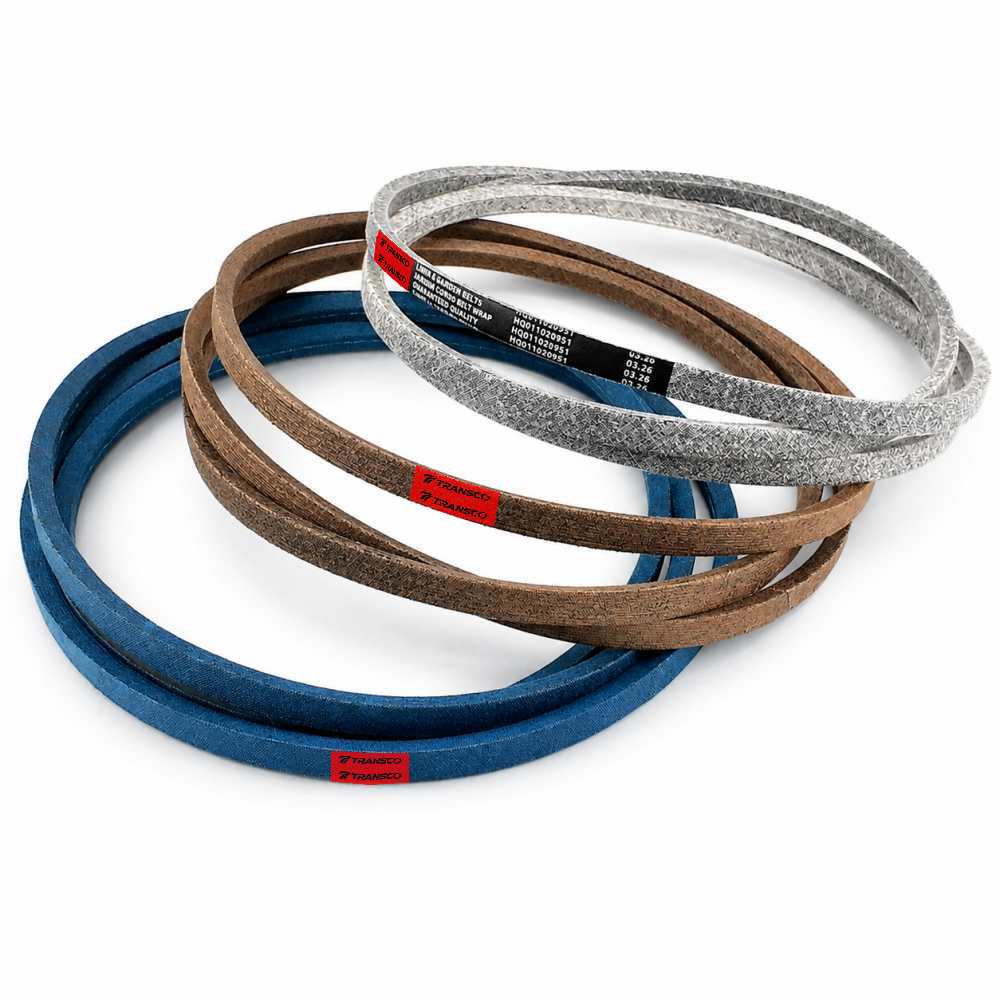
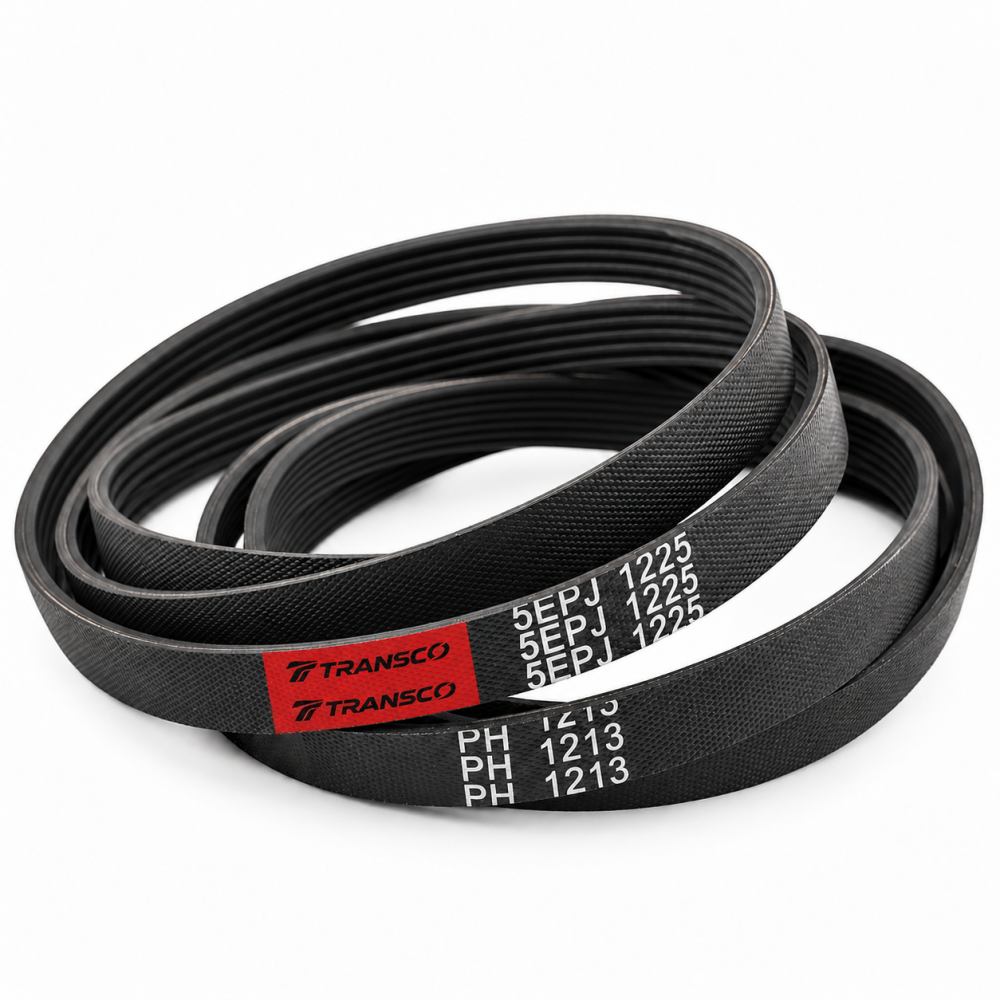
TRANSCO manufactures replacement lawn mower belts for importers, wholesalers and outdoor power equipment parts distributors. Discuss aramid cord mower deck belts and selected drive belt applications, matched by reference number, dimensions, drawing or sample.
Send your item list and quantities for review. Private label requests, minimum order quantities, sample arrangements and lead times are confirmed for each order. Custom development inquiries from mower manufacturers are also welcome.
Features:
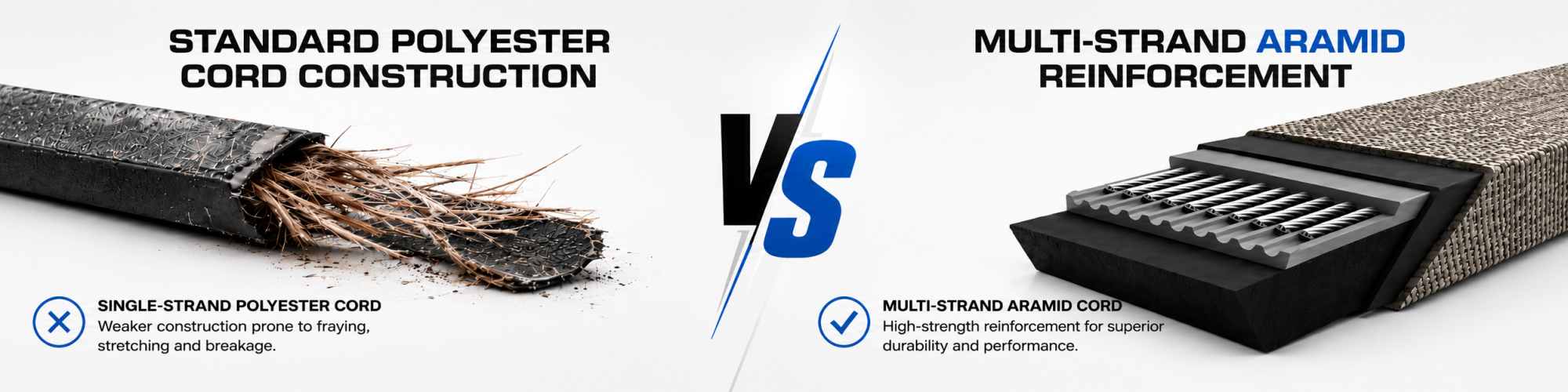
Aramid Cord: High tensile strength with low elongation.
Wear Resistant: Reinforced fabric cover for demanding mower use.
Stable Drive: Reliable pulley engagement and power transmission.
OEM Matching: Supports matching by reference, drawing or sample.
Lawn Mower Belt Definition:
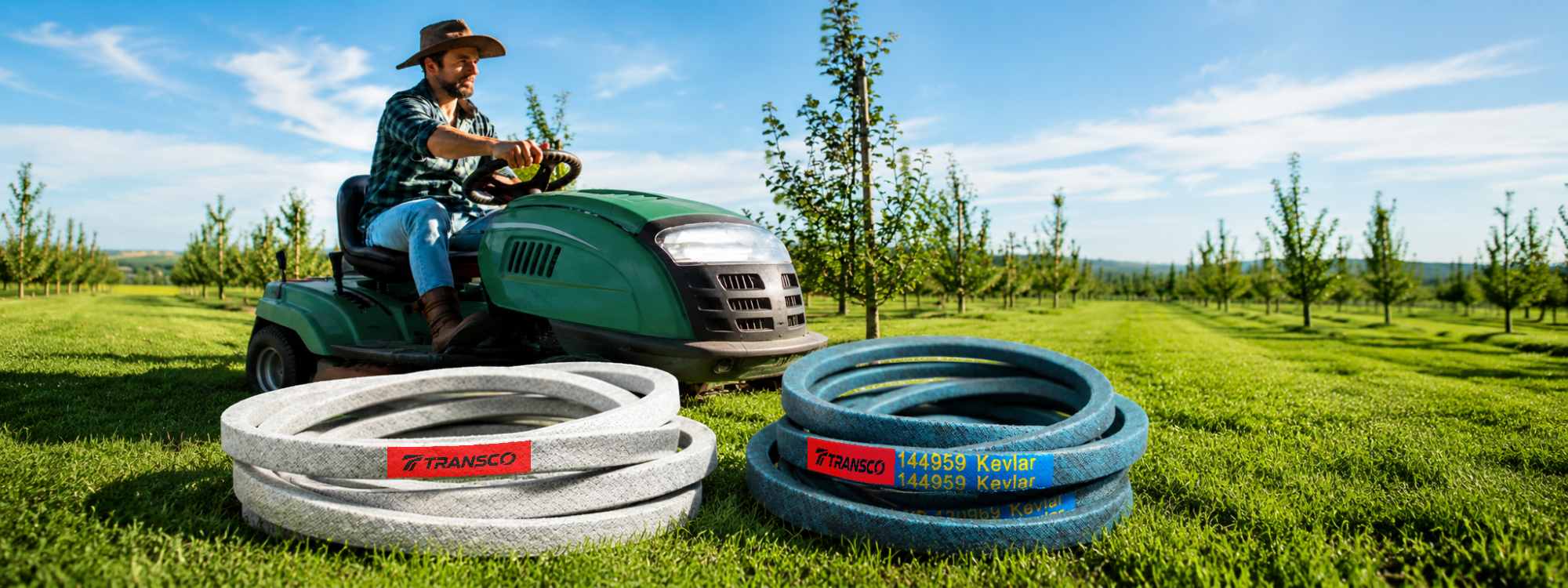
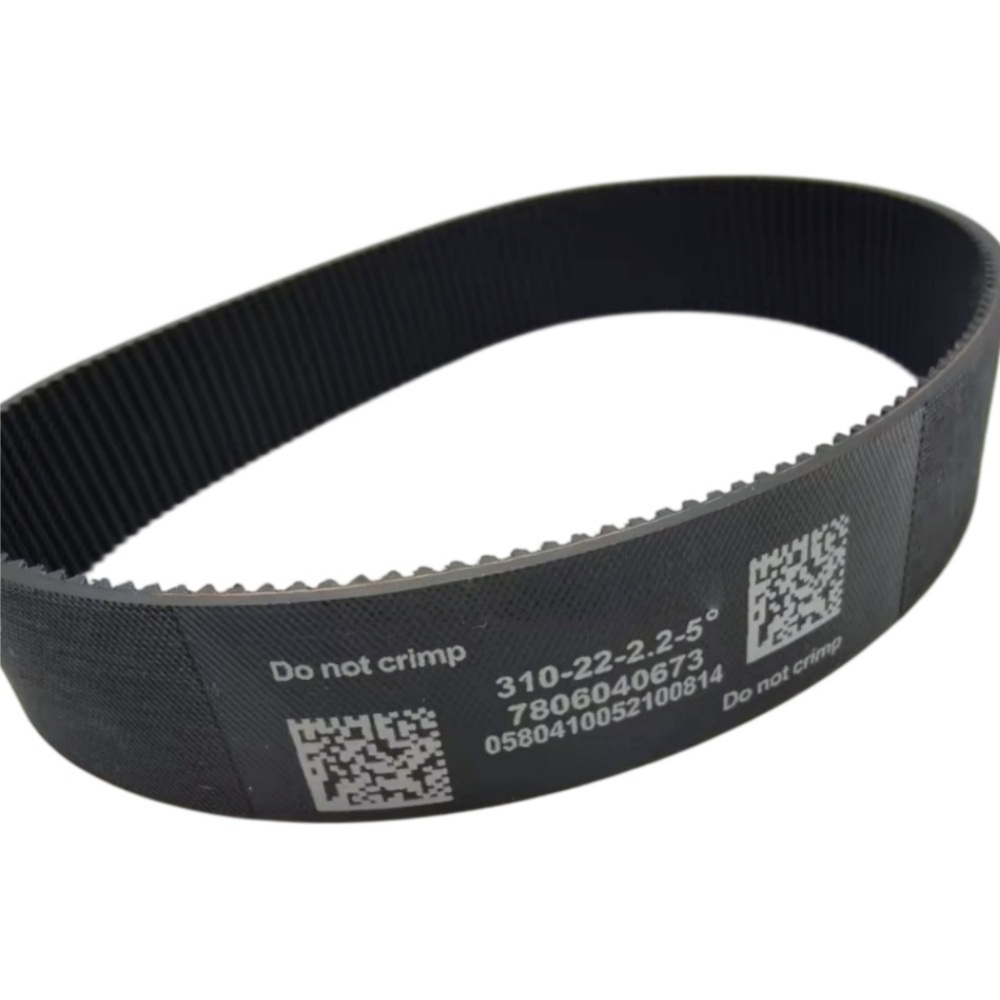
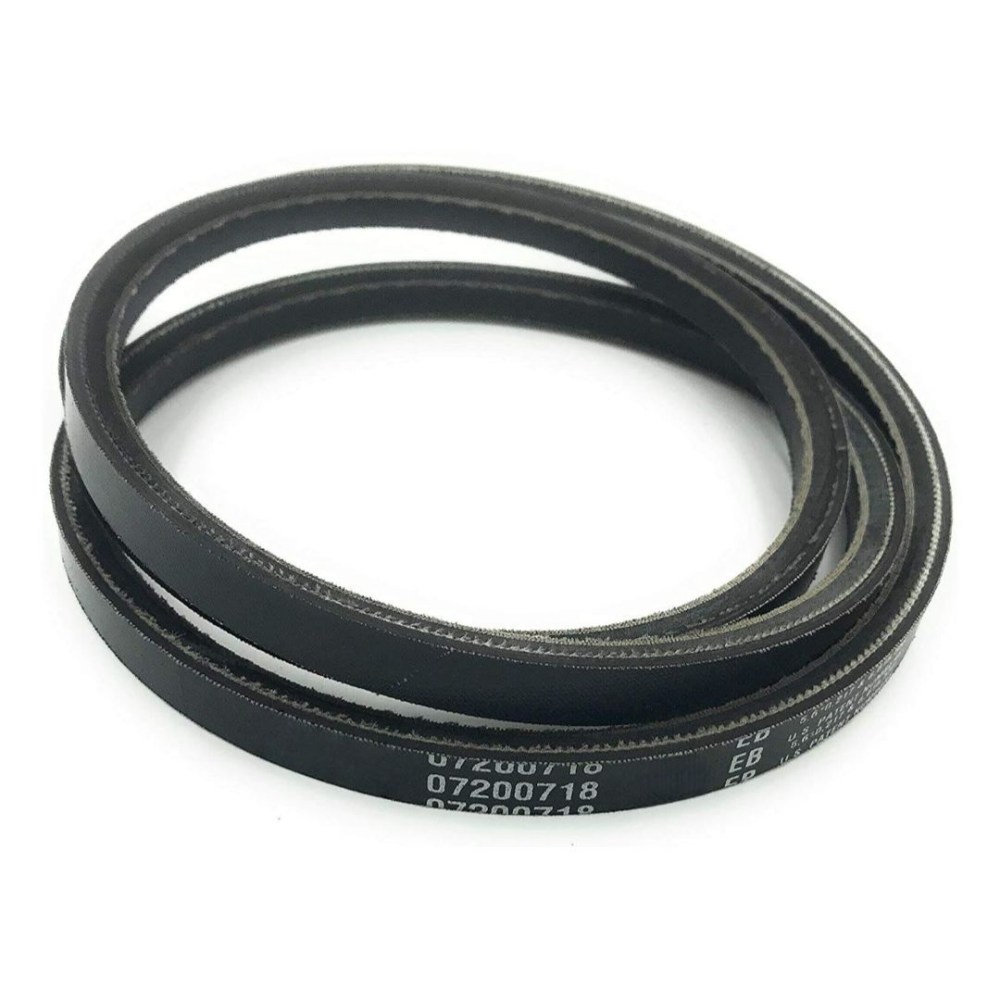
A TRANSCO lawn mower belt is a rubber power transmission belt used in riding mowers, lawn tractors, garden tractors and outdoor power equipment. It transfers power from the engine or pulley system to the cutting deck, blades or transmission drive, helping the mower complete stable cutting and movement during operation.
Typical Application:
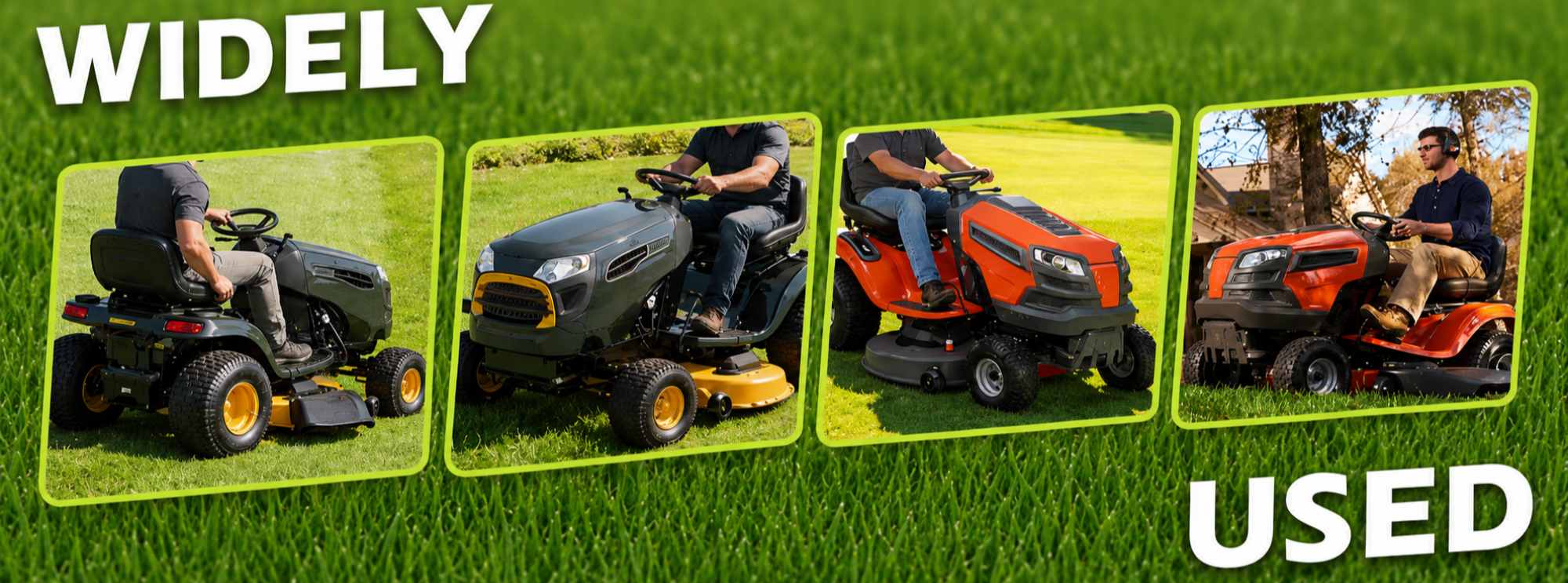
This belt is commonly used for riding mower deck drive, lawn tractor deck drive, mower blade drive, pulley drive systems, transmission drive and clutching drive applications. It is suitable for mower repair shops, garden equipment distributors, aftermarket lawn mower parts suppliers and users who need a reliable replacement belt for outdoor power equipment.
Replacement Mower Belts for Wholesale Supply
TRANSCO is a lawn mower belt manufacturer supplying replacement belts for importers, wholesalers and outdoor power equipment parts distributors. Our mower belt range includes fabric-wrapped rubber belts reinforced with aramid tensile cords for selected deck and drive applications. Each belt is matched to its intended use by reference number, dimensions, construction and equipment details.
Whether you are building an aftermarket parts range or sourcing belts for repeat orders, send us your item list and quantities. We review specification matching, marking and packaging requirements before confirming the quotation. Custom belt development requests from mower manufacturers are also welcome.
Looking for wholesale lawn mower belts?
Send your belt references and quantities for review.
Mower Deck Belts and Drive Belts: Choose the Correct Application
A mower deck belt transfers power to the cutting blades. A mower drive belt transfers power within the machine's movement or transmission system. These functions can require different belt lengths, profiles and constructions, even on the same mower.
Belt application
What to identify before ordering
Mower deck or blade drive belt
Exact deck configuration, belt routing, OEM reference and cutting deck width.
PTO-to-deck belt
The belt running from the power take-off drive to the deck; identify the correct stage on systems with multiple belts.
Traction or transmission drive belt
The specific movement or transmission drive, machine model and original belt reference.
Zero-turn mower belt
Whether the request is for the deck, pump or another drive; these belts are not automatically interchangeable.
Riding mowers, lawn tractors and zero-turn mowers can use several belts with different functions. Identify the belt position on each item in your order, rather than using the mower model alone.
Construction
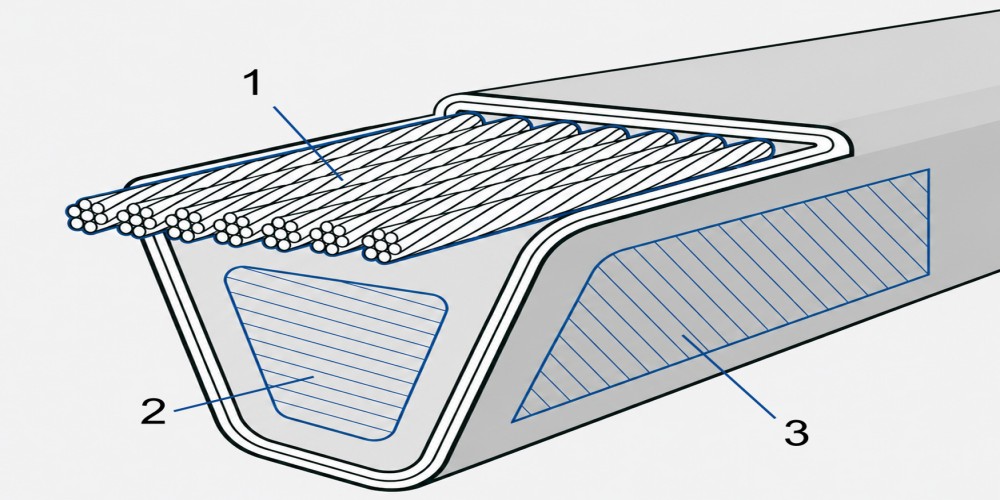
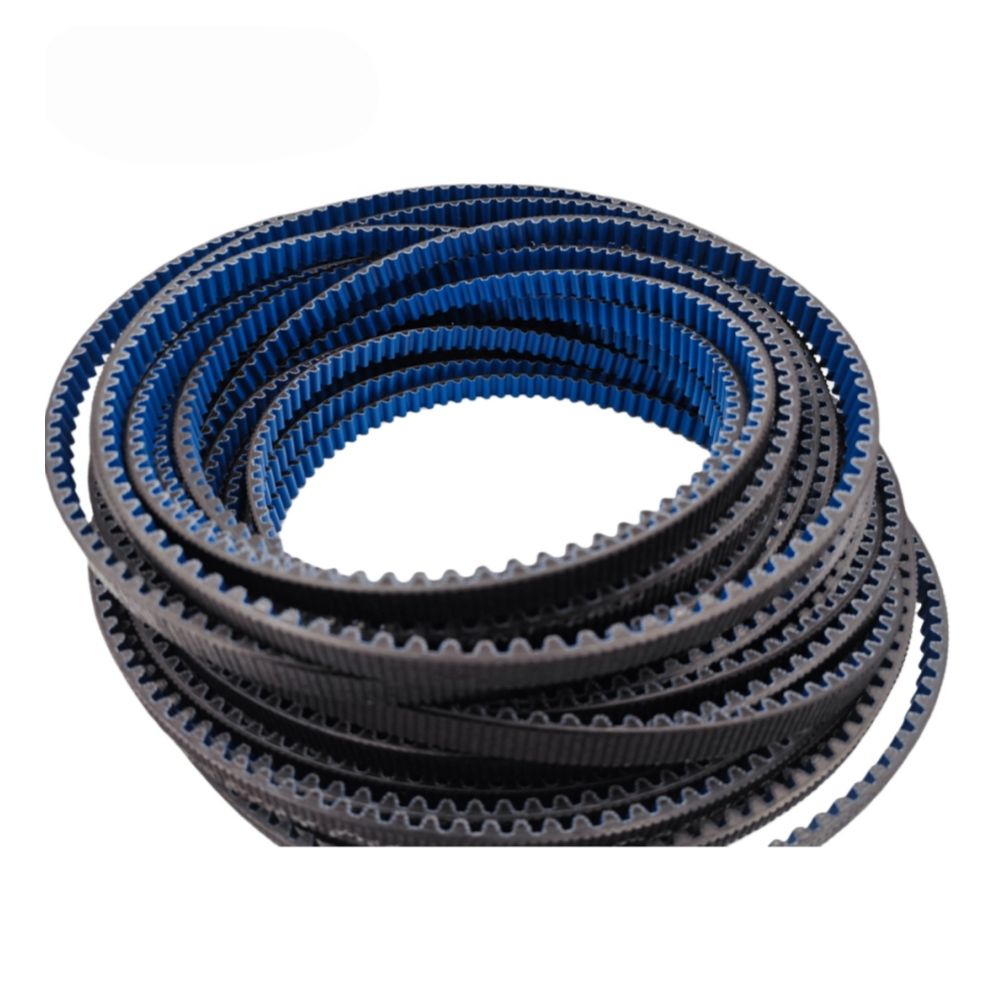
The construction described here combines aramid tensile cords, a flexible rubber body and a wrapped fabric cover. Final material and construction requirements are confirmed for the selected belt specification.
1. Aramid Tensile Cords:
Aramid reinforcement provides tensile strength and helps limit elongation under load. For mower belts, cord selection is relevant to repeated engagement, changing loads and dimensional stability. The appropriate cord construction depends on the drive requirements; the material name alone does not establish a belt's load rating or service life.
2. Flexible Rubber Body:
The rubber body supports the tensile cords and allows the belt to flex around pulleys. Compound selection should account for the equipment's operating environment, belt speed and bending requirements. If your application has a specified temperature range or exposure requirement, include it in the inquiry so the proposed construction can be reviewed against it.
3. Wrapped Fabric Cover:
The fabric cover helps protect the belt surface from abrasion. Its friction characteristics also matter in drives that engage and disengage through belt contact. For applications with backside idlers or clutching operation, confirm that the replacement construction is suitable for that drive layout.
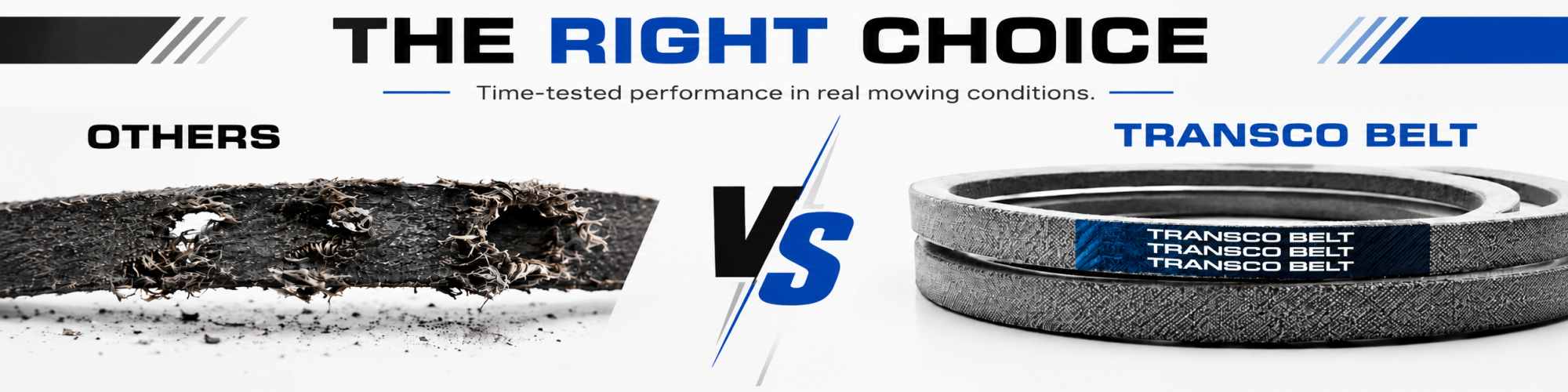
Why choose TRANSCO Mower Belts?
•High-Strength Aramid Tensile Cord
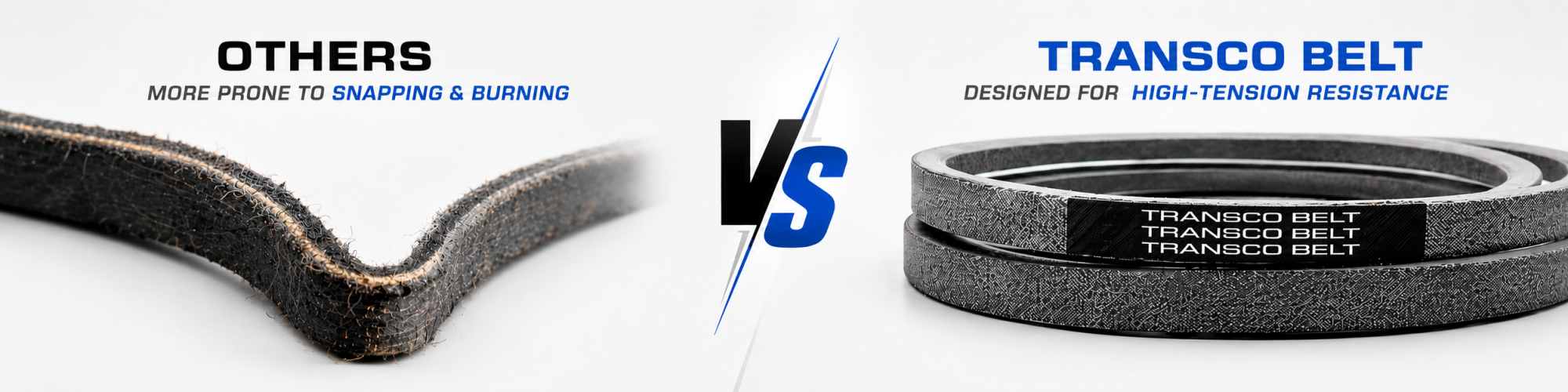
: TRANSCO lawn mower belts use high-strength aramid tensile cords to withstand repeated clutch engagement, sudden load changes and shock loads in mower deck and lawn tractor drive systems. Aramid tensile material provides approximately 190 cN/tex tensile strength, compared with about 81 cN/tex for conventional polyester, while remaining flexible enough for repeated bending around mower pulleys and idlers. This reinforced construction is suitable for heavy-duty mower belts, mower deck belts, riding mower belts and lawn tractor drive belts operating under frequent start-stop conditions.
•Low Elongation & Dimensional Stability
: Aramid reinforcement combines high tensile strength with low elongation, helping the mower belt maintain a stable effective length and operating tension over repeated drive cycles. Typical aramid tensile material has approximately 4% elongation at break and reaches about 73 cN/tex tension at 2% elongation, compared with approximately 14% elongation at break and 15 cN/tex at 2% elongation for polyester. Lower elongation helps reduce belt stretch, tension loss and slippage while supporting consistent blade speed and power transmission in zero-turn mowers, riding mowers and mower deck drive systems.
•-30°C to +60°C Operating Temperature
: The heat- and wear-resistant belt construction is designed for an operating temperature range of approximately -30°C to +60°C (-22°F to +140°F). The rubber body withstands frictional heat generated by continuous bending, pulley contact and repeated clutching while maintaining the flexibility required for outdoor lawn and garden equipment. Controlled heat resistance helps reduce premature hardening, cracking and performance loss during extended mower operation.
•Abrasion-Resistant Dry Fabric Cover
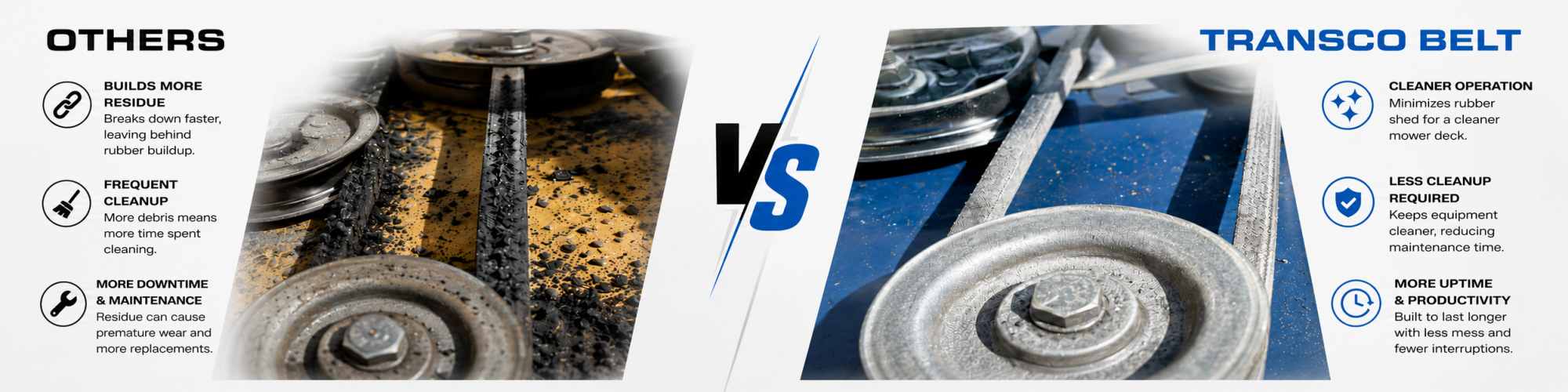
: A durable dry wrapped fabric cover protects the rubber body and internal tensile cords against pulley abrasion, grass debris, dust and repeated surface contact. The fabric surface provides controlled friction rather than excessive grip, supporting smoother engagement and disengagement while reducing surface wear and heat buildup. This construction is particularly suitable for mower deck drives, blade drive systems and applications using backside idlers or tensioning pulleys.
•Controlled Clutching & Shock-Load Performance
: Lawn mower drive systems frequently combine clutch engagement, shock loading, reverse bending and backside-idler operation. TRANSCO mower belts are designed to maintain stable V-groove contact during these changing loads while allowing controlled engagement between the belt and pulley. The combination of aramid tensile reinforcement, flexible rubber and wrapped fabric helps reduce unnecessary slipping, vibration and sudden belt grabbing while supporting reliable power transmission to the mower deck and blades.
•Measurable Quality & Performance Testing
: TRANSCO lawn mower belts can be verified through dimensional, tensile, elongation, heat-resistance and wear-performance testing. Routine inspection covers belt width, height, length, profile accuracy, appearance and construction consistency, while performance testing can evaluate tensile strength, elongation behavior, heat aging and wear resistance. For OEM replacement and aftermarket mower belt projects, additional inspection can be carried out according to customer drawings, OEM reference numbers, belt dimensions and application requirements.
Belt Specifications and Matching Information
Accurate specifications help distributors avoid ordering a belt that looks similar but does not match the application. Use your drawing or the equipment's parts documentation as the reference wherever possible.
Specification
Information to provide
OEM or existing belt reference
Complete number, including any prefix, suffix or revision.
Belt profile
Section, top width and height, or a dimensioned cross-section drawing.
Belt length
Value, unit and measurement basis: inside, outside, effective or another specified convention.
Length tolerance
Required tolerance and measurement method, if specified.
Belt construction
Cord material, rubber requirements, cover construction and any special drive conditions.
Equipment details
Brand, full model, serial range or year where relevant, and cutting deck configuration.
Application position
Deck, blade, PTO-to-deck, traction, transmission or pump drive.
Commercial requirements
Quantity per item, marking, packaging, destination country and required schedule.
Dimensions may be submitted in inches or millimeters. Do not compare two belt lengths until their measurement basis is clear. An outside length and an effective length are not the same specification. A worn belt may also have stretched, so its measured length should not be the only reference used for production.
Similarly, a “42-inch mower deck belt” describes the deck application, not a belt that is 42 inches long. Different mowers with the same deck width can require different belts.
Common Mower Deck Belt Problems
Blades Not Spinning
If the engine runs but the mower blades do not engage, the deck belt may be broken, slipping, or unable to transfer power to the cutting deck. Also check the PTO clutch, pulleys, spindle bearings, and belt tension.
Belt Slipping
A stretched, glazed, or incorrectly sized mower belt can slip under load. This may cause weak blade engagement, squealing noise, uneven cutting, or reduced mowing performance.
Belt Keeps Coming Off
If the mower deck belt keeps coming off, check the belt routing, belt size, idler pulleys, tension spring, spindle alignment, pulley wear, and belt guards before replacing.
Cracks, Glazing, or Burning
Visible cracks, frayed edges, shiny glazed sidewalls, or a burnt rubber smell are common signs that the mower belt is worn and should be replaced before it fails during mowing.
How to choose a Mower Belt?
Choosing the correct lawn mower belt requires more than matching a similar width or deck size. A mower may use separate belts for the cutting deck, blade drive, PTO, traction or transmission system, and different versions of the same machine can require different belt specifications.
For accurate replacement, identify the belt in the following order.
Check the OEM or Existing Belt Number:
Start with the OEM part number or existing reference printed on the original belt. This is usually the fastest way to narrow down the correct replacement.
Record the complete number, including any prefix, suffix or revision. For example, references such as 954-04060C, 754-04060 or 954-05056 should be checked as complete part numbers rather than shortened to a similar reference.
An OEM number is an important identification reference, but it should still be checked against the machine model and belt application before the replacement is confirmed.
Confirm Whether It Is a Deck Belt or Drive Belt:
Identify exactly where the belt operates on the mower.
A mower deck belt transfers power to the cutting deck and blade spindle system, while a drive, traction or transmission belt transfers power through the machine's movement system.
Depending on the equipment, the mower may also use a separate PTO-to-deck belt, blade drive belt or pump drive belt.
These belts are not automatically interchangeable, even when they are installed on the same mower.
Confirm the Machine Model and Deck Configuration:
Check the complete mower brand, machine model and, where available, product number, serial range or production year.
Also identify the cutting deck configuration when selecting a deck belt.
Deck size can be a useful reference, but a 42-inch, 46-inch, 48-inch or 54-inch deck does not identify the belt by itself. Different machines with the same cutting width may use different belt lengths, profiles and routing arrangements.
Use the machine model and deck configuration together with the OEM reference whenever possible.
Verify the Belt Profile and Length Measurement:
If the original part number is unavailable or cannot be confirmed, check the belt dimensions carefully. Important information includes the belt profile, top width
,
Belt height,
Belt length,
Length measurement method.
For belt length, specify whether the value is inside length, outside length, effective length or another defined measurement.
Do not compare two belt lengths until the measurement basis is known. For example, an outside length and an effective length are not the same specification.
A used mower belt may also have stretched during service, so the measured length of a worn belt should not be used as the only production reference.
Check the Pulley and Drive Layout:
Before confirming or installing a replacement belt, inspect the complete drive layout. Check the drive pulley, idler pulleys
,
Spindle pulleys,
Tensioner,
Bearings,
Belt guides,
Belt routing.
Also confirm whether the belt operates with backside idlers, repeated clutch engagement or reverse bending.
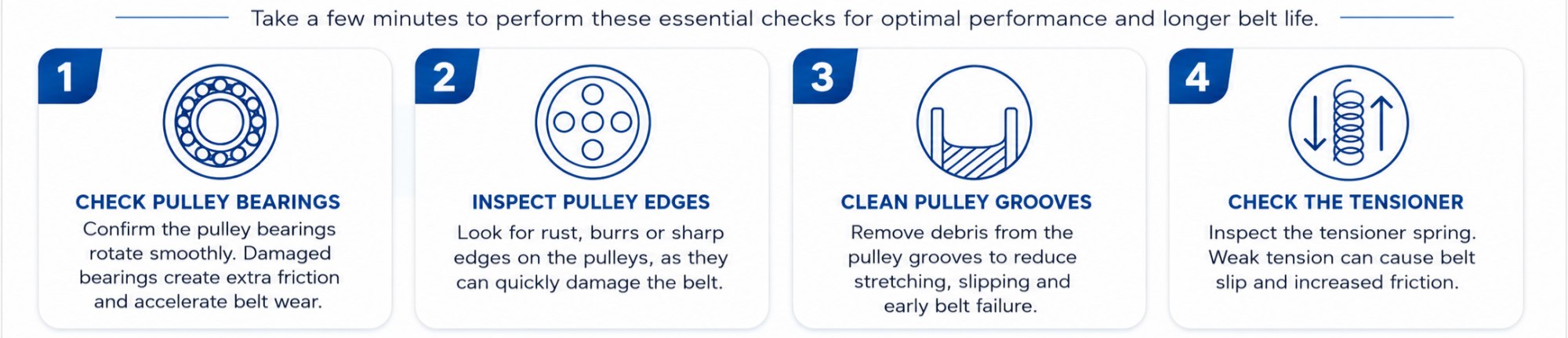
Pulley condition and routing are important because a correct replacement belt cannot compensate for a seized bearing, damaged pulley, weak tensioner or incorrect installation.
Repeated slipping, derailment, overheating or breakage may therefore indicate a machine-side problem rather than an incorrect belt alone.
Send a Sample or Drawing if Identification Is Uncertain:
If the OEM number is missing, unreadable or cannot be matched reliably, provide an original belt sample, technical drawing or clear dimensional information.
For sample-based matching, include the equipment information and identify whether the belt is used for:
Deck Drive / Blade Drive / PTO-to-Deck / Traction / Transmission / Pump Drive.
A physical sample or dimensioned drawing is particularly useful for discontinued references, special profiles or belts where the original specification cannot be confirmed from the machine information alone.
TRANSCO can review the available reference, dimensions, application and equipment details before confirming the proposed replacement belt.
Installation Checks for Replacement Belt Orders
Correct belt selection and the condition of the drive system both affect performance. A replacement belt cannot compensate for a seized bearing, damaged pulley or incorrect routing.
Before inspection or replacement, stop the engine, remove the key and follow the equipment manufacturer's instructions for isolating power and preventing accidental starting. Check the specified routing, pulley condition, idlers, guards and tensioning system before returning the equipment to service.
If a customer reports repeated slipping, belt derailment or breakage, record the belt reference, equipment details and operating symptoms. Photos of the belt marking and drive layout can help distinguish a specification mismatch from a machine-side issue.
OEM Reference Matching for Aftermarket Orders
An OEM reference number is an important starting point for identifying a replacement lawn mower belt, but the part number alone does not always confirm final compatibility.
TRANSCO reviews aftermarket mower belt requirements using the OEM or existing belt reference together with belt dimensions, equipment information, application position, drawings or original samples. This helps reduce the risk of selecting a belt that has a similar appearance but a different length, profile or drive function.
Equipment Brands We Can Review:
TRANSCO reviews replacement belt inquiries for selected lawn and garden equipment from manufacturers such as John Deere, Husqvarna, Cub Cadet, Troy-Bilt, Craftsman, MTD, Toro, Ariens, Exmark, Gravely, Scag, Kubota, Ferris and other outdoor power equipment brands.
Brand name, mower family or cutting deck width alone does not confirm belt compatibility.
How We Confirm Mower Belt Compatibility?
For accurate aftermarket belt matching, we recommend confirming the following information:
1. OEM or Existing Belt Reference
2. Exact Equipment Model
3. Belt Application Position
Provide the complete part number printed on the original belt or listed in the equipment parts documentation.
Include any:
prefix / suffix / revision / superseded number
where applicable.
Examples of mower belt references may include:
954-04060C
754-04060
954-05056
These numbers are used as identification references and should still be checked against the intended machine and belt position.
Provide the complete:
Brand + Machine Model + Product Number / Serial Range / Production Year
, where available.
Using only a general series name may not be sufficient because different versions of the same mower family can use different drive systems.
Confirm exactly where the belt is used.
Typical mower belt positions include:
Mower Deck Belt
Blade Drive Belt
PTO-to-Deck Belt
Traction Belt
Transmission Drive Belt
Pump Drive Belt
A mower deck belt and a traction or transmission belt are not automatically interchangeable, even when both are installed on the same machine.
4. Cutting Deck Configuration
5. Belt Dimensions and Profile
6. Drawing, Photo or Original Sample
For mower deck belt applications, provide the cutting deck size and configuration where known.
Typical deck sizes may include:
42 in / 46 in / 48 in / 50 in / 54 in / 60 in
However, deck width is only one reference point.
A
42-inch mower deck does not mean the belt itself is 42 inches long
, and two machines with the same deck width may require different belts.
These measurements should not be treated as interchangeable.
If the OEM number is unavailable, unreadable or uncertain, send:
a technical drawing, clear belt photos or an original physical sample.
This is especially useful for:
Discontinued mower belts
Special belt profiles
Old equipment
Unclear OEM cross-references
Custom replacement projects
TRANSCO can review the available information before confirming the proposed replacement specification.
Bulk Orders and Private Label Requirements
Importers and parts distributors often need more than an individual replacement belt. The order may include several item numbers, different quantities and packaging that fits an existing parts range. Share these requirements with your inquiry so we can review the complete order.
Mixed-Item Purchasing Lists:
List each belt reference, specification and quantity separately. Mixed-item requests are reviewed according to the product specifications and production requirements. Minimum quantities and the feasibility of combining items are confirmed for the order.
Belt Marking and Packaging:
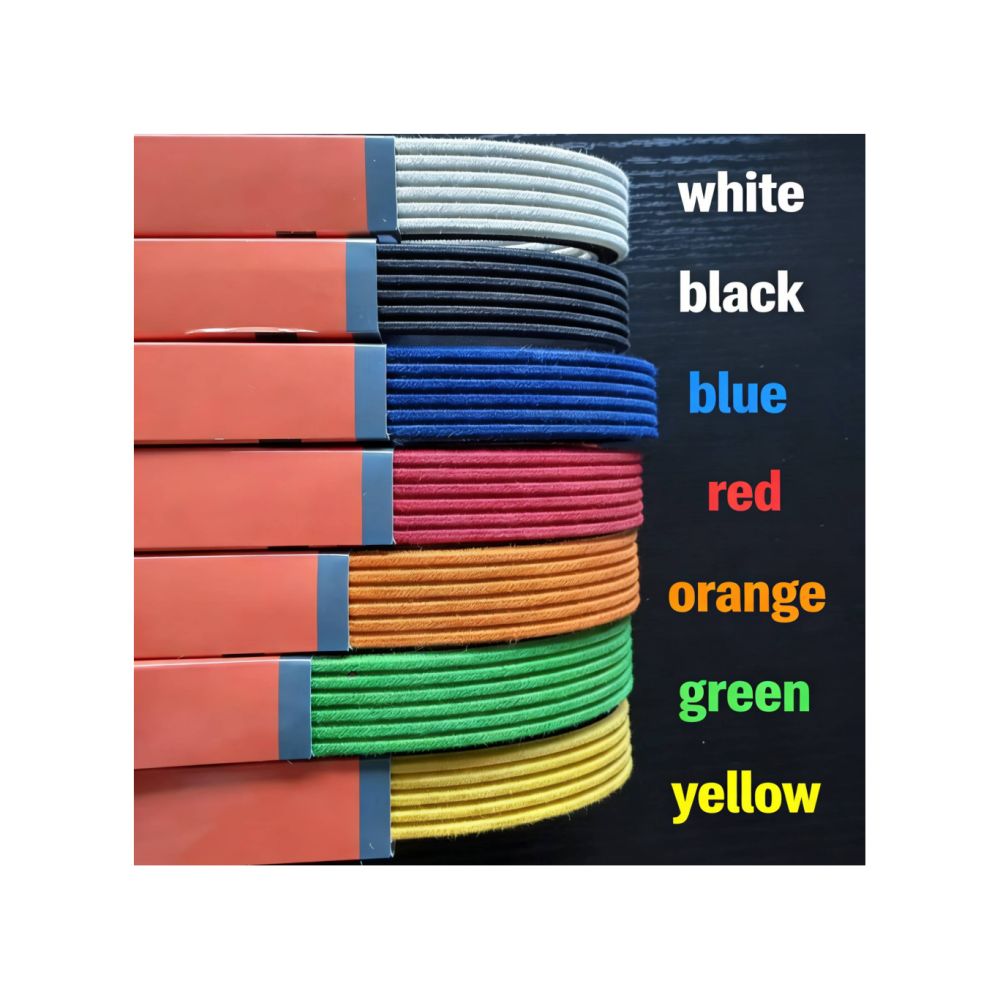
Private label requests can include belt printing, item identification and packaging artwork. Provide your branding requirements, label content and any barcode or carton marking requirements. Available options, costs and minimum quantities are confirmed after review.
Samples and Repeat Orders:
Sample availability, costs and timing are confirmed for the requested specification. For repeat orders, reference the previously agreed drawing or specification and highlight any changes to construction, marking or packaging. This gives both sides a clear basis for confirming the new order.
Pricing and Lead Times:
Pricing, minimum order quantities and production lead times depend on the belt specification, quantity per item and packaging requirements. Provide your destination country and requested arrival date as well as your preferred order schedule. Production lead time and transport time should be confirmed separately when planning replenishment.
Specification Review and Quality Requirements
A purchasing specification should define how the belt will be identified and checked. Before placing a bulk order, agree on the relevant dimensions, tolerances, construction, marking and acceptance requirements.
Dimensional checks:
belt length, measurement basis, top width, height and profile.
Construction requirements:
tensile reinforcement, rubber body and fabric cover for the intended application.
Identification checks:
belt printing, item reference and packaging information.
Performance requirements:
any specified tensile, elongation, heat-aging or wear test, including the method and acceptance criteria.
Include any required inspection documents or test reports in your inquiry. Their availability and scope are confirmed for the order. A general material property or photograph should not be used as a substitute for the agreed finished-belt specification.
Custom Belts for Mower Manufacturers
TRANSCO also reviews custom belt development requests for mower and outdoor power equipment manufacturers. Share the drawing, belt profile and length, drive function, operating requirements and expected order quantity.
Where available, include pulley sizes, idler arrangement, engagement method and duty cycle. These details help define the proposed belt construction and sample requirements. Development feasibility, sample arrangements and production terms are confirmed after technical review. Final application validation should be agreed with the equipment manufacturer before production approval.
Frequently Asked Questions
A
Yes. TRANSCO supplies replacement lawn mower belts to importers, wholesalers, outdoor power equipment parts distributors and aftermarket replacement suppliers.
For bulk inquiries, send your OEM references, belt specifications, required quantity for each item, packaging requirements and destination country. We will review the purchasing list and confirm the available specifications, production requirements and commercial terms.
A
For accurate identification and quotation, please provide as much of the following information as possible:
OEM part number, mower brand, exact machine model, deck size, belt application position, belt profile, width, height, length, required quantity and packaging requirement.
A clear photo of the original belt marking, equipment nameplate, technical drawing or physical sample is also useful when the specification cannot be confirmed from the OEM number alone.
A
The minimum order quantity depends on the belt specification, production process, quantity per reference and packaging requirements.
There is no single MOQ that applies to every lawn mower belt. Existing production items may have different requirements from newly developed or customized belts.
Send your complete purchasing list and required quantity for each item so TRANSCO can confirm the applicable MOQ.
A
Yes, mixed-item purchasing requests can be reviewed.
Please provide each OEM reference or belt specification together with the required quantity. TRANSCO will confirm whether the items can be combined in one order and identify any reference-specific MOQ, tooling, production or packaging requirements.
This is particularly useful for distributors sourcing multiple mower deck belt and drive belt references in one shipment.
A
Yes. TRANSCO can review lawn mower belt requirements according to OEM reference number, mower model, belt position, deck configuration and belt dimensions.
However, an OEM number alone does not always confirm final compatibility. Different production years, deck configurations or drive layouts may use different belts.
For accurate matching, provide the complete equipment information whenever possible.
OEM numbers and mower brand names are used for aftermarket replacement identification and compatibility reference. They do not indicate that TRANSCO products are genuine parts manufactured by the original equipment brand.
A
A mower deck belt transfers power to the cutting deck and blade spindle system.
A drive belt, also called a traction or transmission belt in some applications, transfers power through the mower's movement or transmission system.
The same mower may use separate belts for these functions, so the application position should always be confirmed before ordering.
Typical deck-belt terms include:
Mower Deck Belt / Cutting Deck Belt / Blade Drive Belt / PTO-to-Deck Belt
Typical drive-belt terms include:
Drive Belt / Motion Drive Belt / Traction Belt / Transmission Belt
Your current page already makes this distinction, so this FAQ should remain because it is both a common buyer question and an important selection issue.
A
No.
A 42-inch, 46-inch, 48-inch or 54-inch deck size describes the cutting deck width; it does not directly specify belt length or guarantee belt compatibility.
Different mower models with the same deck width can use different belt profiles, lengths, pulley layouts and OEM references.
The correct belt should be confirmed using:
OEM number + exact machine model + deck configuration + belt position + belt dimensions
Your current page already correctly states that deck size alone is insufficient, so this point should be retained but made more concise in the FAQ.
A
Yes. TRANSCO can review dimensions provided in either inches or millimeters, provided the measurement method is clearly identified.
For belt length, specify whether the value is:
Inside Length (Li)
Outside Length (La)
Effective / Pitch Length (Le/Lp)
or another defined measurement.
For example, simply providing “96.5 inches” without specifying the measurement method may not be sufficient for accurate production.
Where available, provide a technical drawing, original belt sample or complete dimensional specification.
A
Yes.
If the OEM number is unavailable, discontinued or unreadable, TRANSCO can review the belt according to an original sample, technical drawing or confirmed dimensional data.
Sample-based development may include checking:
belt profile, top width, height, length, wrapping structure, tensile reinforcement and application requirements.
For special or discontinued replacement belts, a physical sample is often the most reliable reference for technical confirmation before production.
A
Aramid tensile cords are widely used in heavy-duty mower belts because they provide high tensile strength, low elongation and good resistance to shock loading.
However, cord material alone does not determine whether a belt is suitable for a particular mower.
The correct belt also depends on:
belt profile, dimensions, rubber compound, fabric cover, pulley arrangement, clutching conditions, bending direction and transmitted load.
Therefore, buyers should confirm the complete belt construction and application rather than selecting a replacement only because it uses aramid cord.
This is more accurate than your current FAQ wording that broadly says an aramid belt is “better” for heavy-duty use.
A
Yes. TRANSCO supports private-label and customized marking requirements for bulk orders.
Available options can include:
customer brand marking, OEM reference printing, custom belt labels, individual packaging, bulk packaging, barcodes, cartons and customer-supplied artwork.
Please provide the required artwork, item identification, packaging format and quantities for review.
Availability, pricing and minimum quantities are confirmed according to the specific project.
A
Sample availability, sample cost and production lead time are confirmed after the belt specification and required quantity have been reviewed.
For custom development, provide:
OEM reference, technical drawing or sample, application information, dimensions, required quantity, destination country and target delivery schedule.
Existing belt references and newly developed items may require different production times.
Production lead time and international transportation time should also be considered separately when planning the required delivery date.