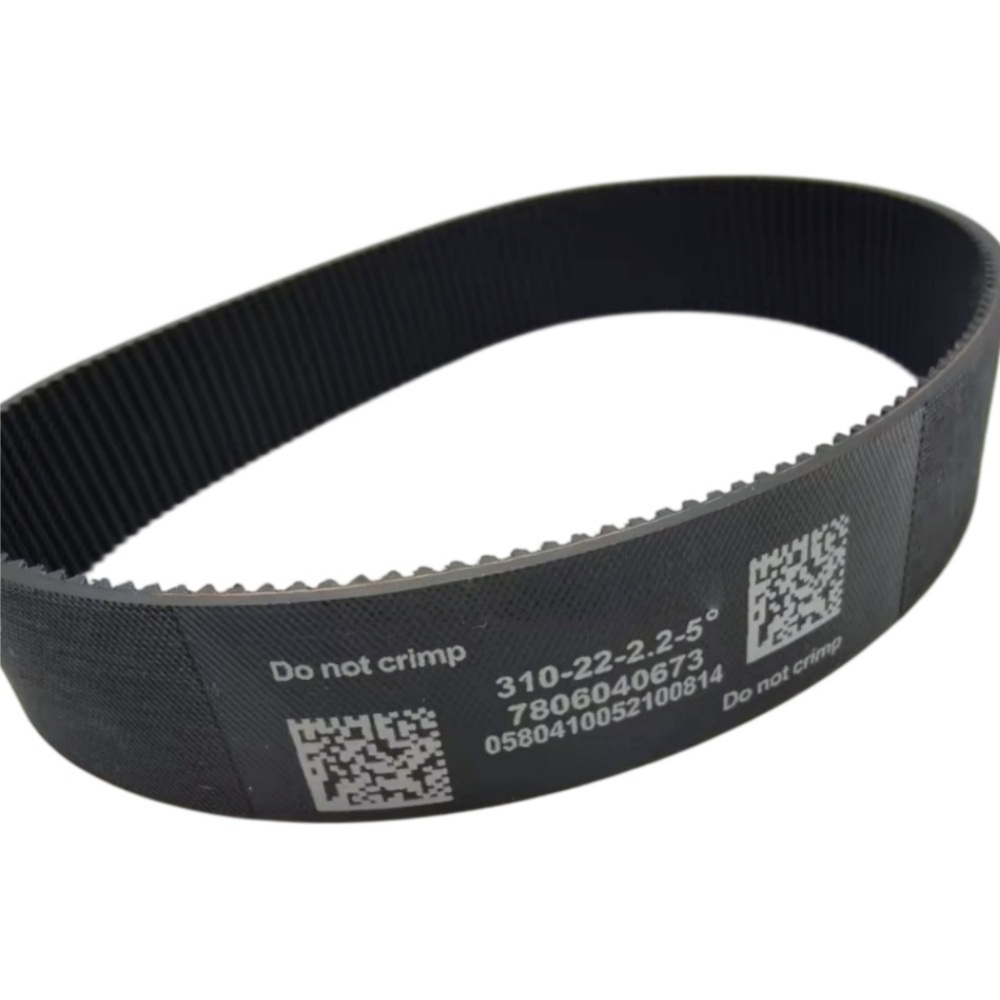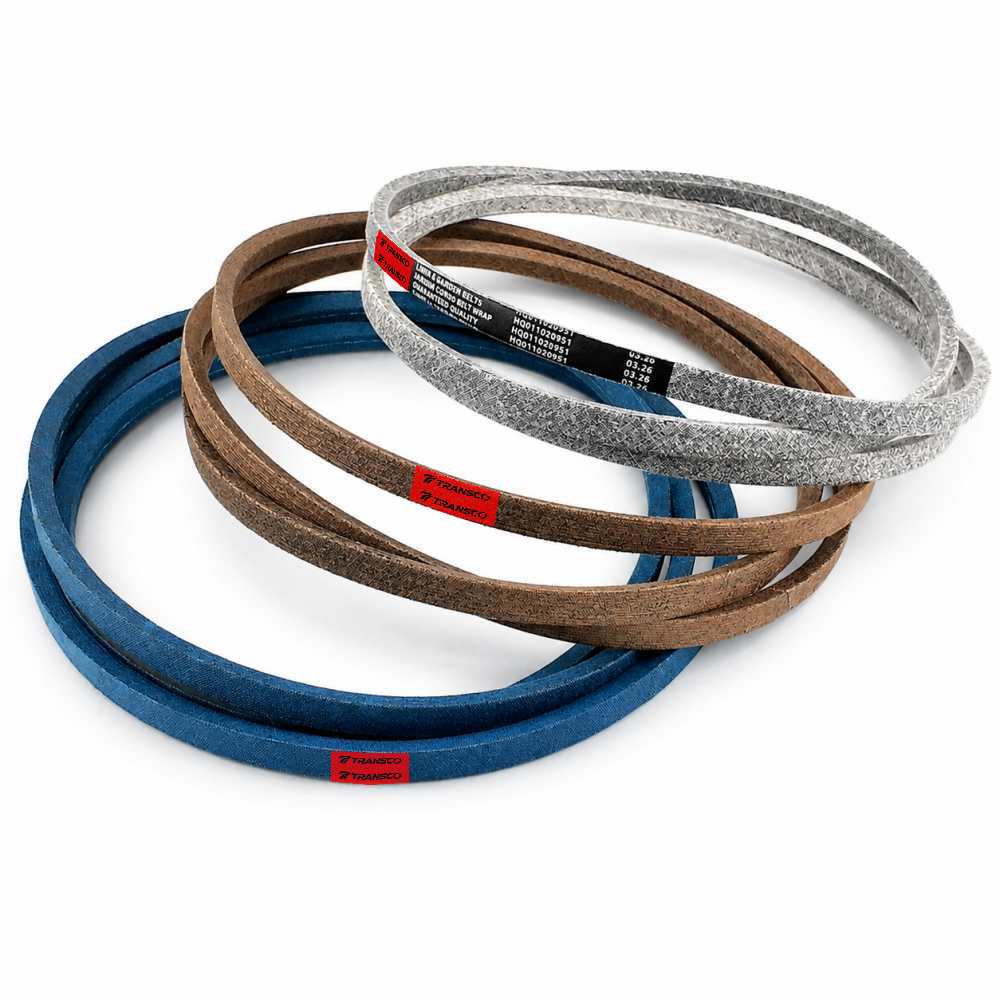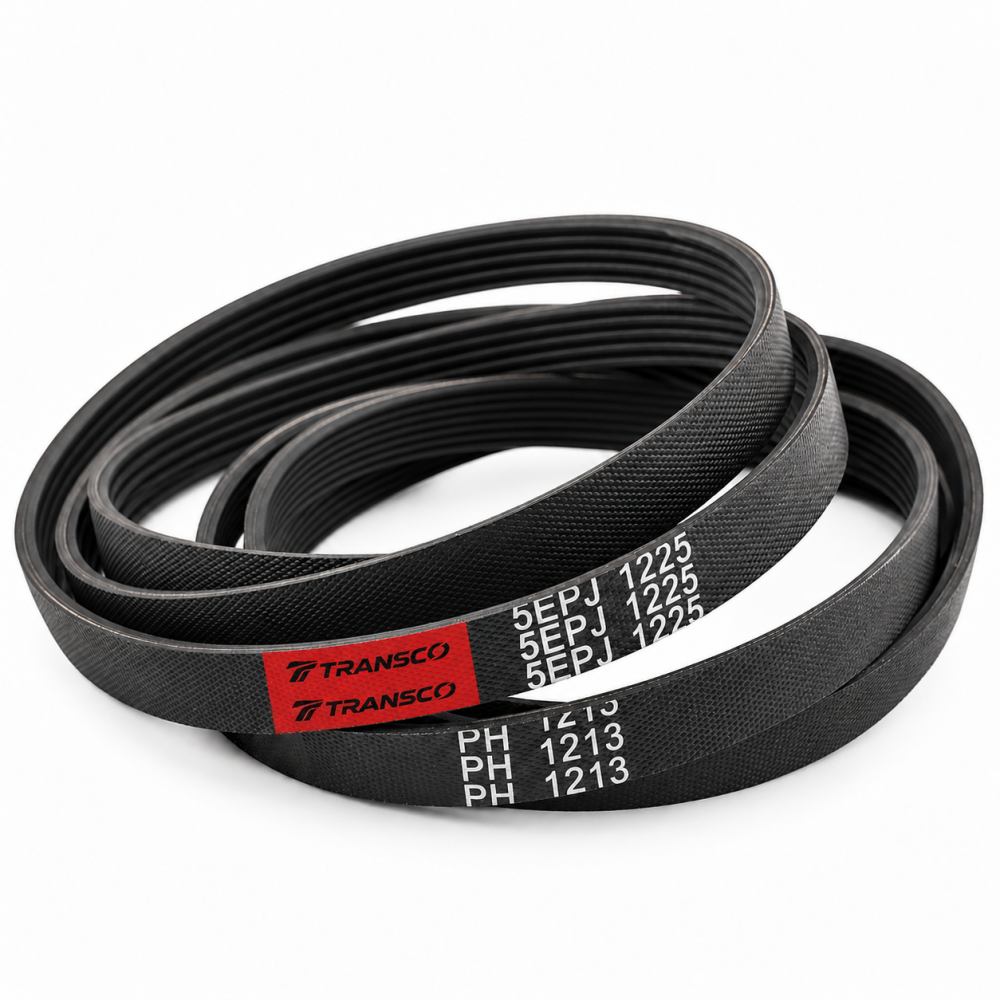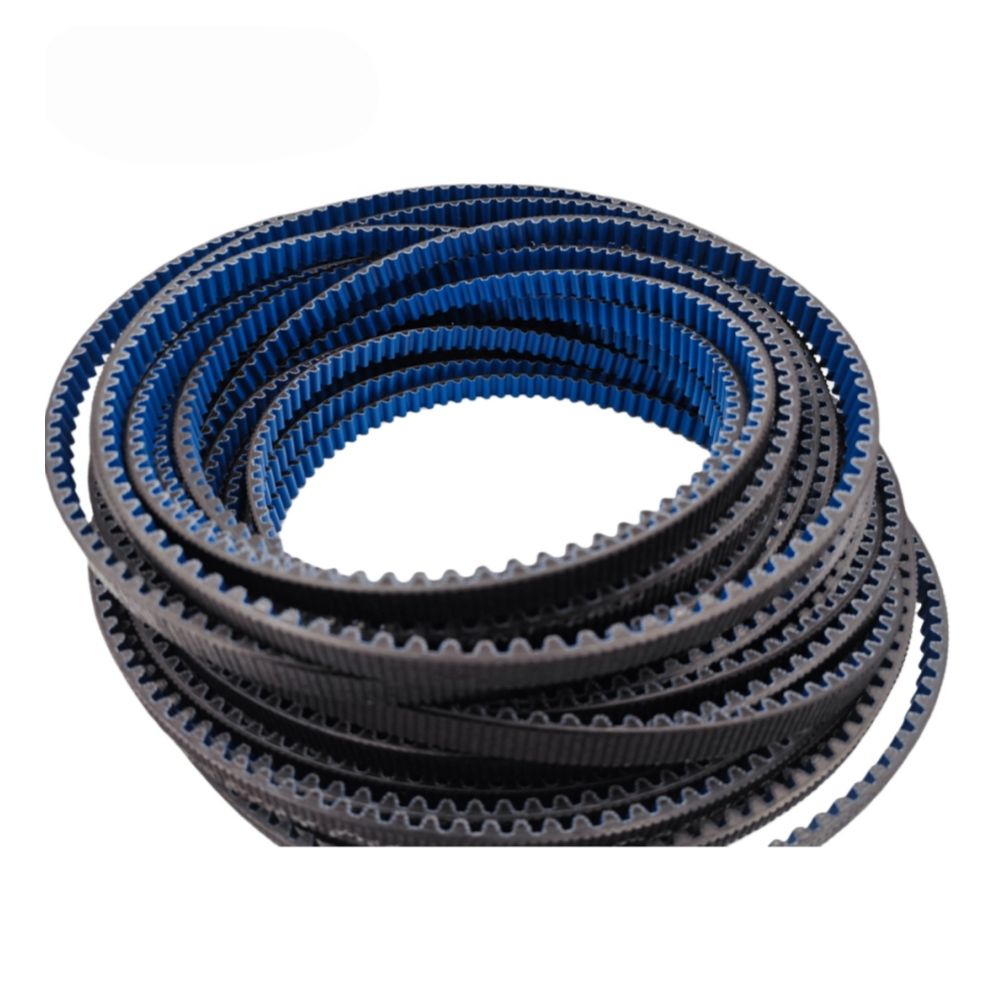
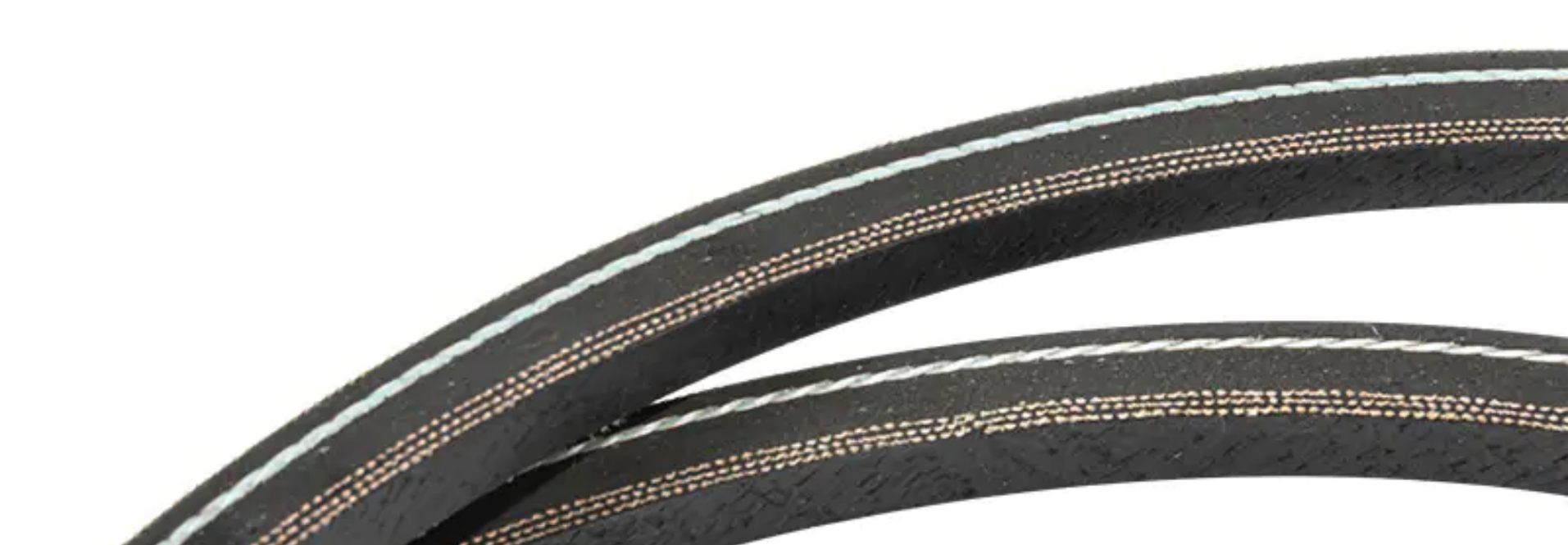
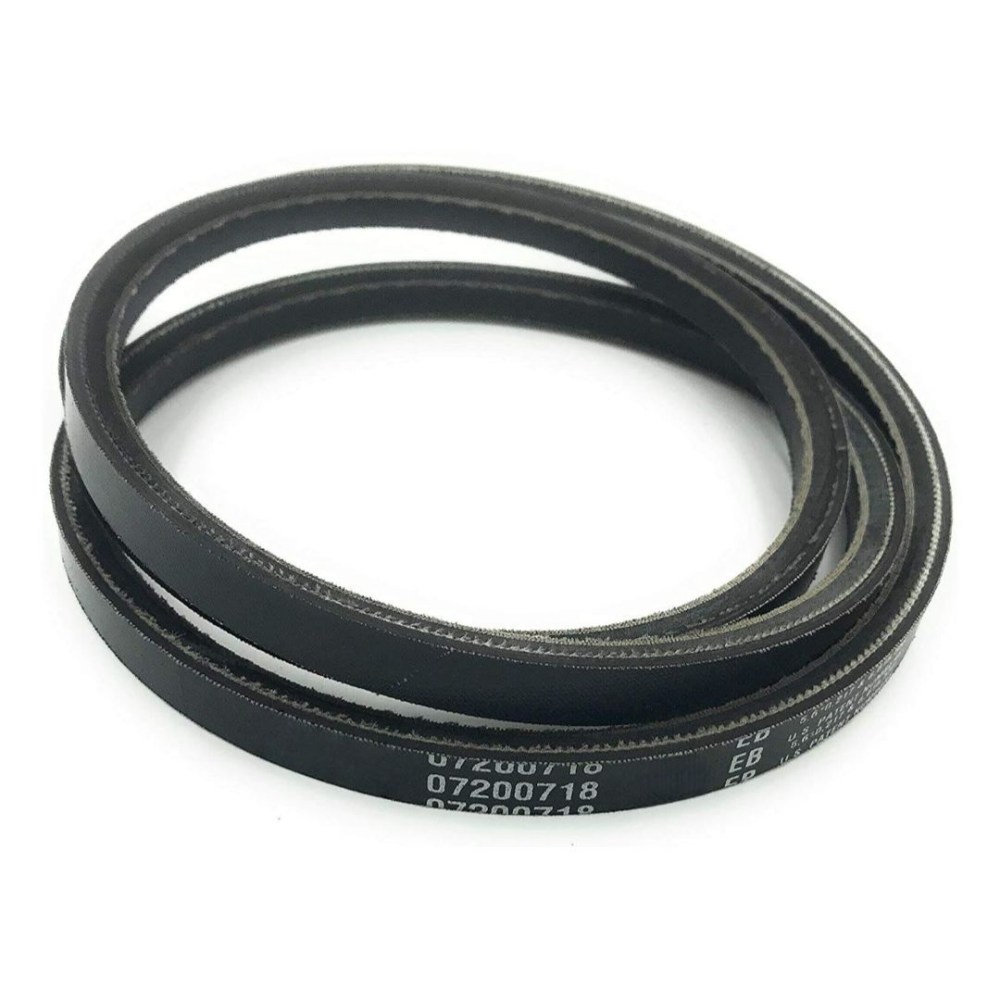
Raw Edge Plain & Laminated V-Belts
We offer two distinct constructions: the Raw Edge Plain V-Belt with a conventional rubber compression body and the Raw Edge Laminated V-Belt, also known as a Raw Edge Multi-Ply V-Belt, with multiple fabric-rubber reinforcement layers integrated into the lower belt body. The laminated construction can regulate excessive gripping, improve transverse stability and help reduce associated vibration and operating noise under suitable conditions.
What Are Raw Edge Plain & Laminated V-Belts?
Raw Edge Plain and Raw Edge Laminated V-Belts are friction-driven, non-cogged rubber belts that transfer rotational power between matching V-groove pulleys. The Plain version is a conventional raw edge drive belt; the Laminated version is a multi-layer fabric-reinforced raw edge V-belt with additional lower-body support.
Unlike a wrapped V-belt, a raw edge V-belt has exposed rubber driving sidewalls rather than a continuous fabric covering around the belt. This rubber sidewall V-belt design delivers strong direct pulley contact and effective torque transmission without confusing a smooth inner surface with the toothed profile of a timing belt.
Both constructions have a smooth inner surface without molded transverse cogs or notches. We may also describe this construction as a smooth-bottom raw edge V-belt, a non-notched raw edge V-belt or a non-cogged raw edge V-belt. All three descriptions refer to the absence of inner-surface notches, not to the absence of V-groove frictional drive.
Our raw edge belts serve selected automotive engine accessory systems, agricultural machinery, heavy equipment and industrial motor-driven equipment. Properly selected CR or EPDM compounds, tensile cords and rubber-fabric layers help resist abrasion, flex fatigue and repeated load variations.
The correct construction depends on the actual drive: friction characteristics, cross-sectional profile, pulley compatibility, speed, operating load, temperature and noise requirements. A customer looking for a raw edge V-belt without cogs must still confirm dimensions and performance rather than assuming all non-cogged V-belts are interchangeable.
Raw Edge V-Belt Construction
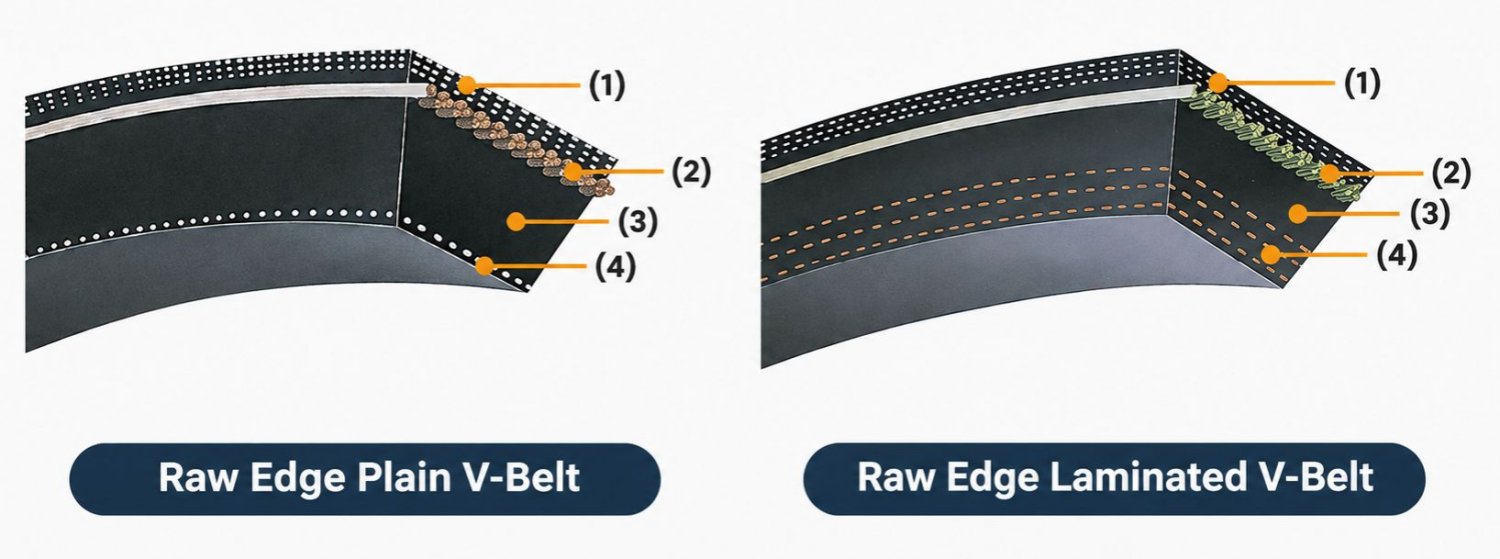
TRANSCO Raw Edge Plain and Laminated V-Belts feature protective fabric, polyester or aramid tensile cords, CR or EPDM rubber compounds and reinforced lower rubber structures. Both are non-cogged raw edge V-belts with exposed rubber sidewalls, while their lower reinforcement constructions differ.
① Fabric: Our protective layer uses cotton or other specified rubber-treated industrial fabrics to resist abrasion, mechanical damage and repeated flexing. The flexible woven structure protects the internal belt components, while rubber treatment improves adhesion and helps prevent premature layer separation.
② Tensile Cord: Our high-strength tensile reinforcement provides load-carrying capacity, low elongation and dimensional stability.
Polyester Tensile Cord (PET) : Offers balanced tensile strength, fatigue resistance and controlled stretch for conventional automotive, agricultural and industrial raw edge V-belts.
Aramid Tensile Cord : Provides higher tensile strength and lower elongation for selected high-load drives requiring improved dimensional stability.
We apply controlled cord twisting, continuous spiral winding and appropriate pretensioning or stabilization processes according to the selected construction. These processes help maintain consistent reinforcement, reduce initial stretch and support long service life.
③ Rubber: TRANSCO offers CR and EPDM rubber compounds for different operating environments.
Chloroprene Rubber (CR) : Provides flexibility, abrasion resistance, flex-crack resistance and moderate resistance to certain oils. Our CR rubber raw edge V-belts are suitable for selected automotive and industrial applications.
EPDM Rubber : Offers excellent heat, ozone, weathering and ageing resistance. Our EPDM raw edge V-belts support applications requiring thermal durability but are generally unsuitable for prolonged exposure to petroleum-based oils or fuels.
Optional Aramid Fiber Reinforcement : Aramid fiber-reinforced rubber improves transverse stiffness and deformation resistance in selected constructions. Unlike aramid tensile cords, these fibers reinforce the rubber body rather than carry the primary longitudinal tension.
Cushion Rubber — Adhesion & Load Distribution : Our cushion rubber surrounds and bonds the tensile cords to adjacent layers, distributing operating stress and reducing the risk of delamination during repeated bending.
Compression Rubber — Wear & Fatigue Resistance : Our compression rubber supports the belt's cross-sectional shape and resists abrasion, compression fatigue, shock-related deformation and flex cracking. Formulations are selected to control heat build-up and maintain durability under specified loads, pulley speeds and temperatures.
④ Fabric/Rubber:
Raw Edge Plain V-Belt : Our Plain construction features a conventional compression rubber body with a protective fabric-rubber bottom layer. It provides flexibility, wear resistance and strong frictional engagement through exposed rubber sidewalls.
Raw Edge Laminated V-Belt : Our Laminated construction, also known as a Multi-Ply V-Belt, incorporates multiple rubber-bonded fabric layers within the lower belt body. This laminated fabric-rubber reinforcement improves transverse stability, distributes bending stresses and helps control excessive pulley gripping.
Under suitable operating conditions, the laminated structure can reduce friction-related vibration and operating noise while supporting fatigue resistance and long service life. We select Plain or Laminated construction according to pulley geometry, transmitted load, friction requirements and operating conditions.
Raw Edge Plain vs. Raw Edge Laminated V-Belts
Raw Edge Plain V-Belt — Conventional Compression-Rubber Construction
Our Raw Edge Plain V-Belt has a conventional compression rubber body, fabric-free side faces and a smooth, non-cogged bottom. This plain raw edge rubber V-belt is designed to provide direct V-groove contact and dependable mechanical flexibility.
Direct rubber-to-pulley engagement supports high gripping capacity and low-slip operation when pulley condition, alignment and tension are appropriate. Polyester or aramid cord reinforcement helps maintain dimensional stability and resist repeated bending.
A raw edge plain V-belt can be a practical choice for selected automotive fan and alternator drives, farm equipment and general industrial machinery. Application suitability remains dependent on section dimensions, the particular belt formulation and pulley geometry.
Raw Edge Laminated V-Belt — Integrated Fabric-Rubber Reinforcement
Our Raw Edge Laminated V-Belt uses multiple fabric layers integrated into the lower rubber body. Sometimes called a multi-ply laminated V-belt or laminated fabric rubber V-belt, it is not merely a conventional Plain belt with extra surface wrapping. Its fabric-rubber composite is an internal structural difference.
These laminated layers help distribute repeated bending stresses, provide transverse support and regulate frictional response. In correctly designed drives, they can reduce excessive rubber gripping and contribute to more stable operation, with potential noise and fatigue benefits.
Compared with a Plain construction, a low-noise raw edge laminated V-belt is particularly relevant when friction-related vibration and running stability matter. The belt is not inherently silent, and measured noise depends on belt tension, pulley alignment, condition and load.
The practical comparison between raw edge plain and laminated V-belts must consider the complete product construction, rubber compound, reinforcement arrangement, pulley geometry and service conditions; neither design is universally better.
Longitudinal belt elongation is principally controlled by the tensile cord material, cord treatment and stabilization. Multiple lower fabric layers do not, by themselves, establish a lower longitudinal elongation value.
For customers comparing raw edge laminated versus wrapped V-belts, the critical distinction is that Laminated belts retain fabric-free rubber sidewalls while using fabric reinforcement inside the body. A plain raw edge drive belt and a laminated fabric-reinforced belt can therefore share a non-cogged external shape without having identical internal constructions.
Construction & Performance Comparison
| Feature | Raw Edge Plain | Raw Edge Laminated |
| Inner Surface | Smooth, non-cogged | Smooth, non-cogged |
| Driving Sidewalls | Exposed rubber | Exposed rubber |
| Main Construction | Conventional compression rubber body | Rubber body with laminated reinforcement |
| Lower Reinforcement | Conventional fabric-rubber protection | Multiple integrated fabric-rubber layers |
| Friction Characteristics | Strong direct rubber grip | Controlled friction characteristics |
| Transverse Stability | Supported by rubber compound and reinforcement | Additional stability from laminated layers |
| Bending Fatigue Resistance | Reinforced rubber structure | Additional stress distribution through laminated layers |
| Noise Characteristics | Depends on drive conditions | Designed to help reduce excessive gripping and associated noise |
| Rubber Options | CR / EPDM | CR / EPDM |
| Tensile Cord Options | Polyester / Aramid | Polyester / Aramid |
Raw Edge V-Belt Key Features & Benefits
·Reliable Power Transmission & Strong Pulley Grip:
Our Raw Edge Plain and Raw Edge Laminated V-Belts use fabric-free rubber driving sidewalls for high frictional engagement with compatible pulley grooves. This supports reliable power transmission, high gripping capacity and reduced unwanted slippage when the drive is correctly aligned and tensioned. The belt’s capacity depends on pulley geometry, working tension, belt section and load rather than on rubber grip alone.
·High Tensile Strength, Low Elongation & Long Service Life:
Polyester or aramid tensile cords provide high load-carrying strength and dimensional stability. Controlled twisting, winding and stabilization help limit initial elongation and tension loss. With suitable cushion and bottom rubber formulations, these low-elongation raw edge V-belt constructions resist repeated deformation and support long service intervals under the specified conditions.
·Heat, Oil, Abrasion & Environmental Resistance:
Our CR and EPDM compounds address different wear, heat and environmental requirements. CR offers abrasion and flex-crack resistance with moderate resistance to certain oils; EPDM supports heat, ozone, weather and ageing resistance. Specified industrial configurations are available for -25°C to +100°C, while selected automotive Plain and Laminated configurations are described for -30°C to +100°C. These are configuration-specific ranges, not universal ratings, and fluid compatibility must be reviewed separately.
·High Flexibility, Shock Resistance & Fatigue Durability:
Reinforced rubber provides mechanical flexibility and resistance to bending, shock loading, flex cracking and compression fatigue. Specially formulated bottom rubber supports cross-sectional stability during pulley engagement. Laminated fabric-rubber layers provide additional transverse support and help distribute stresses in suitable fluctuating-load applications.
·Controlled Friction, Low Stretch & Reduced Operating Noise:
The Plain design offers direct rubber grip, whereas the Laminated construction can regulate excessive gripping and friction-related vibration. Stable tensile cords help reduce stretch and tension fluctuations; together with proper pulley alignment and tension, this can contribute to quieter running. Noise reduction varies by drive and is not a blanket acoustic guarantee.
·Small-Pulley Compatibility & Stable High-Speed Performance:
Suitable raw edge belt profiles can be selected for relatively high-speed or small-pulley drives only when minimum pulley diameter, belt bending limits, speed, power and installation tension are satisfied. Pulley size and belt length must be checked against the applicable profile, and reverse bending or backside idlers require a separate suitability review.
Raw Edge V-Belt Technical Standards
Operating Temperature & Environmental Performance
TRANSCO evaluates the operating suitability of each Raw Edge Plain and Laminated V-Belt based on its rubber compound, tensile reinforcement, belt profile, transmitted load and duty cycle. For accurate material selection, customers should provide the expected ambient and pulley-area temperatures, continuous or intermittent operating conditions, and any exposure to lubricants, fuels, coolants or other chemicals. We assess fluid type, exposure level and rubber compatibility before confirming the appropriate belt construction and material specification.
Antistatic Performance
Our anti-static raw edge V-belt options are available only in specifically formulated and verified constructions, including selected industrial drives with electrical conductivity requirements. Electrical resistance limits, applicable test methods and acceptance criteria are confirmed according to the selected belt specification.
Where applicable, we can evaluate antistatic performance against ISO 1813:2025, which defines electrical conductivity characteristics and test methods for specified antistatic belts. An antistatic industrial V-belt is specified on the basis of a relevant electrical resistance test; a standard CR or EPDM belt is not automatically antistatic.
Applicable Technical Standards & References
At TRANSCO, we manufacture Raw Edge Plain and Raw Edge Laminated V-Belts for a wide range of automotive, agricultural and industrial applications. Our production and quality control processes are guided by relevant international and regional standards, helping us maintain consistent dimensions, reliable performance and product quality.
| Standard / Reference | Applicable Technical Scope |
|---|---|
| ISO 4184:2025 | Datum-length requirements for applicable classical and metric narrow V-belt sections |
| ISO 2790:2020 | Dimensional requirements for automotive V-belts and corresponding pulleys |
| ISO 1813:2025 | Electrical conductivity requirements and testing for specified antistatic V-belts |
| IS 2494 (Part 1):1994 | General-purpose industrial V-belt specifications for applicable classical sections |
| IS 14261:1995 | Industrial narrow V-belt specifications for applicable sections |
| ARPM / RMA IP-22 | North American narrow V-belt drive references for applicable 3V, 5V and 8V profiles |
| ARPM / RMA IP-23 | North American light-duty V-belt drive references for applicable 2L, 3L, 4L and 5L profiles |
The applicable standards vary depending on the belt section, construction and application requirements. At TRANSCO, we review these requirements during product selection and manufacturing, with dimensional inspections and relevant performance tests carried out according to the agreed specifications. For OEM and customized orders, our engineering team can also assist with technical specifications, product testing and supporting documentation when required.
Specifications
Classical Section Raw Edge V-Belt
|
Section |
Top Width (Tw) (mm) |
Thickness (Th) (mm) |
Angle (θ) (°) |
Min. Pulley Diameter (mm) |
Range Min. (inch/mm) |
Range Max. (inch/mm) |
Lp to La (mm) |
Li to Lp (mm) |
Li to La (mm) |
Length Designation |
|---|---|---|---|---|---|---|---|---|---|---|
|
ZX |
10 |
6 |
36 |
40 |
21.5 / 550 |
200 / 5000 |
16 |
22 |
38 |
Li |
|
AX |
13 |
8 |
36 |
63 |
21.5 / 550 |
200 / 5000 |
14 |
36 |
50 |
Li |
|
BX |
17 |
11 |
36 |
90 |
21.5 / 550 |
200 / 5000 |
26 |
43 |
69 |
Li |
|
CX |
22 |
14 |
36 |
140 |
23.5 / 597 |
200 / 5000 |
32 |
56 |
88 |
Li |
|
DX |
32 |
19 |
38 |
280 |
40.0 / 1016 |
200 / 5000 |
40 |
79 |
119 |
Li |
Narrow Section Raw Edge V-Belt
|
Section |
Top Width (Tw) (mm) |
Thickness (Th) (mm) |
Angle (θ) (°) |
Min. Pulley Diameter (mm) |
Range Min. (inch/mm) |
Range Max. (inch/mm) |
Lp to La (mm) |
Li to Lp (mm) |
Li to La (mm) |
Length Designation |
|---|---|---|---|---|---|---|---|---|---|---|
|
XPZ |
10 |
8 |
36 |
56 |
21.5 / 550 |
200 / 5000 |
13 |
37 |
50 |
Lp |
|
XPA |
13 |
10 |
36 |
71 |
21.5 / 550 |
200 / 5000 |
18 |
45 |
63 |
Lp |
|
XPB |
16.3 |
14 |
36 |
112 |
21.5 / 550 |
200 / 5000 |
28 |
60 |
88 |
Lp |
|
XPC |
22 |
18 |
38 |
180 |
23.5 / 600 |
197 / 5000 |
30 |
83 |
113 |
Lp |
|
3VX |
9.7 |
8 |
38 |
56 |
21.5 / 546 |
200 / 5000 |
13 |
37 |
50 |
La |
|
5VX |
15.8 |
14 |
38 |
112 |
21.5 / 546 |
200 / 5000 |
25 |
60 |
85 |
La |
|
8VX |
25.4 |
23 |
38 |
254 |
90 / 2290 |
200 / 5000 |
53 |
92 |
145 |
La |
Light Duty Raw Edge V-Belts
|
Section |
Top Width (Tw) (mm) |
Thickness (Th) (mm) |
Angle (θ) (°) |
Min. Pulley Diameter (mm) |
Range Min. (inch/mm) |
Range Max. (inch/mm) |
Lp to La (mm) |
Li to Lp (mm) |
Li to La (mm) |
Length Designation |
|---|---|---|---|---|---|---|---|---|---|---|
|
2LX |
6.3 |
4 |
38 |
25 |
21.5 / 550 |
200 / 5000 |
— |
— |
— |
La |
|
3LX |
9.7 |
5.6 |
36 |
36 |
21.5 / 550 |
200 / 5000 |
16 |
22 |
38 |
La |
|
4LX |
12.7 |
7.9 |
38 |
58 |
21.5 / 550 |
200 / 5000 |
14 |
36 |
50 |
La |
|
5LX |
16.7 |
9.7 |
36 |
72 |
21.5 / 550 |
200 / 5000 |
26 |
43 |
69 |
La |
How to Select the Right Raw Edge V-Belt
We help buyers choose the right raw edge V-belt by confirming its construction, exact cross section, length reference, pulley geometry, transmitted power, operating environment and replacement purpose.
Step 1. Choose Plain or Laminated Construction:
Determine whether the application requires a conventional Raw Edge Plain V-Belt or a Raw Edge Laminated V-Belt with multiple fabric-rubber reinforcement layers integrated into the lower belt body. Both constructions feature exposed rubber sidewalls for direct pulley grip, while the Laminated design provides additional transverse stability, bending-stress distribution and controlled friction characteristics that may help reduce vibration and operating noise.
Step 2. Confirm the Belt Cross-Section:
Customers can supply the original code or measurements of top width and belt thickness. Our team checks belt section against the V-groove profile to support correct seating and load transfer. We verify the profile dimensions against the corresponding pulley groove geometry to support correct seating and frictional contact.
Step 3. Verify Belt Length & Reference System:
Verify the original measurement reference—inside length (Li), pitch length (Lp), outside length (La) or datum length (Ld). This avoids selecting a replacement with a similar nominal number but a different reference system. We review the dimensional system to avoid incorrect replacement selection.
Step 4. Check Pulley Diameter & Drive Arrangement:
The V-belt minimum pulley diameter and maximum permissible belt speed are profile- and construction-dependent. We review diameter, center distance, rotational speed, wrap angle and bending conditions before recommending a replacement. We review pulley diameter, rotational speed, center distance and installation conditions. For systems using backside idlers or reverse bending, we conduct a separate technical review of the belt construction, idler diameter, bending direction, contact arrangement and operating tension before confirming suitability.
Step 5. Select Rubber & Reinforcement Materials:
Choose a CR or EPDM raw edge belt formulation for the actual temperature, fluid exposure and ageing conditions. Polyester or aramid cord versions and optional aramid fiber-reinforced rubber are matched to load, dimension control and flexibility. Polyester or aramid tensile cords and optional aramid fiber-reinforced rubber are specified according to the required load, elongation control and belt flexibility.
Step 6. Review Operating & Installation Conditions:
Provide operating power, motor or engine speed, load fluctuation, duty cycle, temperature, pulley condition and tension requirements. With that information, our engineers can assess a raw edge V-belt for fluctuating-load drives or a specified high-speed raw edge V-belt application without promising universal suitability. Correct pulley alignment, suitable installation tension and regular inspection help reduce abnormal wear, unwanted slippage and premature belt failure. If a drive has squealing or slip, possible causes include insufficient tension, pulley misalignment, contamination, glazing, incorrect belt section or excessive load. Our selection review can help clarify whether the problem calls for a different belt specification or adjustment to the drive rather than promising that a new belt alone will eliminate the noise.
Applications
|
|
|
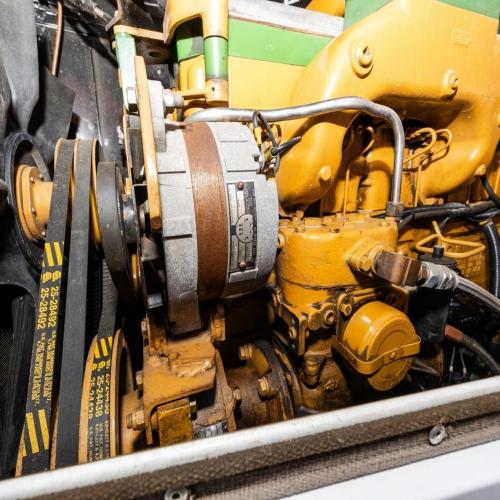
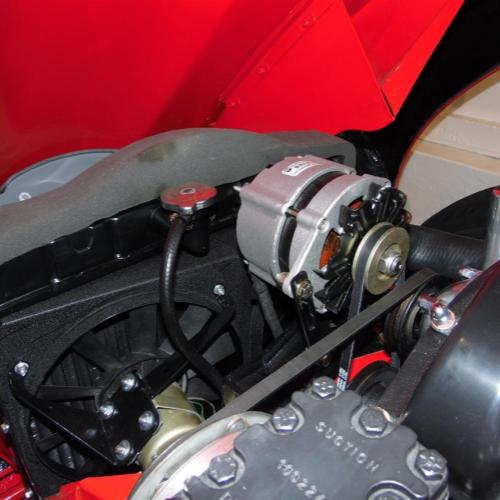
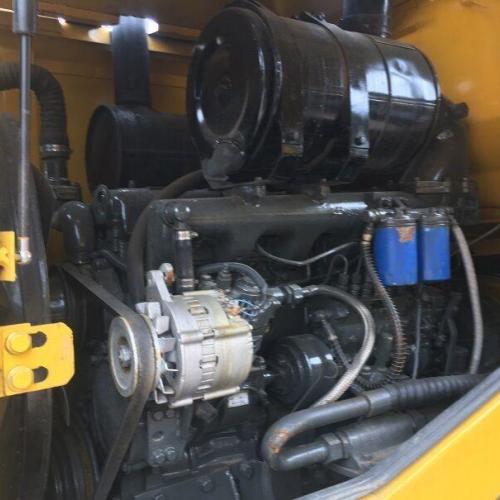
| Trucks, Buses & Heavy-Duty Engine Accessory Drives | Passenger Cars, Microbuses & Light Commercial Vehicles | Construction Machinery & Heavy Equipment |
|
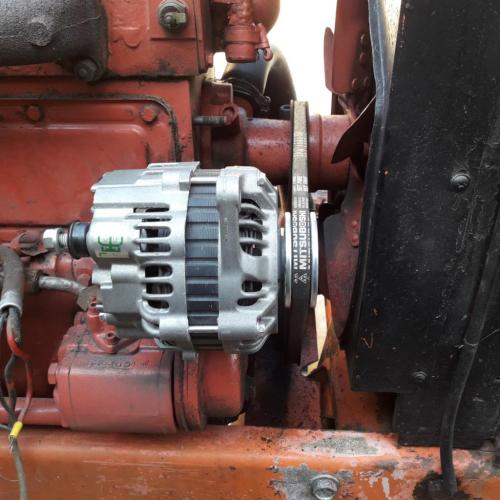
For selected commercial vehicles, TRANSCO supplies heavy-duty truck V-belt and bus-engine fan-belt specifications, including traditional gasoline and diesel-engine accessory drives. Common enquiries involve truck engine fan V-belts, truck alternator V-belts, diesel engine alternator V-belts and selected air-conditioning compressor V-belts. The existing engine pulley layout determines suitability.
In large engine compartments, fan and alternator drives can experience elevated temperatures, vibration and changing loads. We review the original section and length before selecting Plain or Laminated construction for a truck engine cooling fan belt, heavy-duty engine fan V-belt or related heavy-duty replacement. |
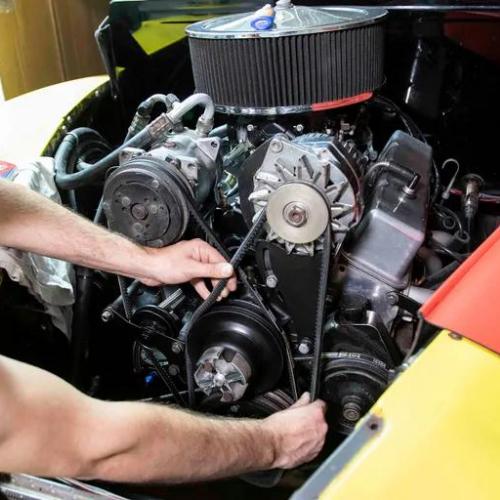
For selected passenger cars, microbuses, minibuses and light trucks using conventional V-groove accessory drives, we provide automotive raw edge V-belt configurations for alternators, engine cooling fans, water pumps and air-conditioning compressors. Typical customer searches include automotive alternator V-belt, automotive AC compressor V-belt, automotive water-pump V-belt and automotive fan belt.
These configurations are particularly relevant to older vehicles originally designed for separate V-belts rather than later serpentine poly-V systems. We evaluate automotive fan belt replacement, light-truck alternator belt replacement and relevant original part numbers against the installed pulley profiles and belt geometry. |
For construction machinery, earthmoving machines and heavy equipment, TRANSCO reviews engine-accessory V-belt applications including engine fan belts, alternator belts and water-pump drives. A construction machinery raw edge V-belt can be supplied only where the original equipment uses a compatible conventional V-groove drive.
Vibration, dust, changing loads and prolonged duty require careful selection of rubber and reinforcement. We assess heavy-duty diesel engine V-belts and off-highway machinery accessory drives without claiming compatibility with hydraulic cooling systems or all excavator and loader models.
|
|
|
|
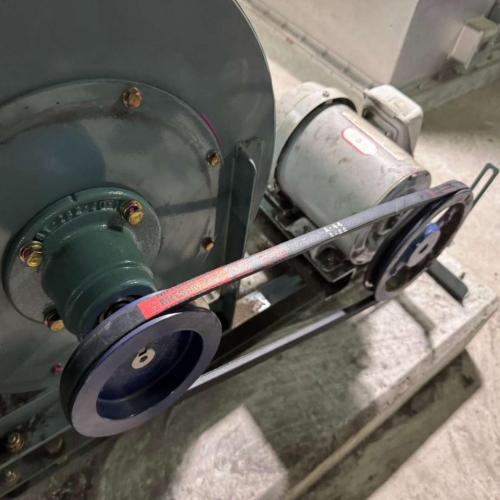
| General Engineering & Industrial Machinery | Agricultural Machinery & Farm Equipment | Automotive & Industrial Maintenance and Replacement Drives |
|
In general engineering, our industrial raw edge plain V-belts and laminated variants support selected industrial fan drives, blowers, ventilation fans, motor-driven pumps, water pumps and air compressors. Buyers commonly search for an industrial fan drive V-belt, air compressor drive V-belt, industrial pump drive V-belt or industrial blower V-belt according to the machine being maintained.
We can review CR rubber raw edge V-belts for industrial fans, wear-resistant raw edge belts for pumps and polyester-cord raw edge V-belts for industrial machinery when the requested properties and profiles are available. These industrial power transmission V-belts must be selected by pulley geometry, belt speed, transmitted load and duty cycle. Industrial belt applications include fans and ventilation units operating continuously, pumps driven by electric motors, and compatible reciprocating compressor drives. Some compressors and blowers use direct drive or toothed/poly-V systems instead; the actual V-groove pulley arrangement must be confirmed. |
We supply agricultural machinery raw edge V-belts for selected farm equipment and engine-accessory drives with compatible pulleys. Common applications include tractor engine fan belts, tractor alternator V-belts, tractor water-pump V-belts, agricultural pump drives and agricultural ventilation fan V-belts.
Farm equipment can experience dust exposure, temperature variations, repeated bending and fluctuating loads. For a farm-equipment V-belt replacement, we confirm the actual drive and old belt section instead of assuming that all agricultural machines use the same belt design. When available, belt markings, pulley dimensions, working conditions and machine photographs help us verify suitable replacements before production or shipment. We avoid assuming that all harvesters or agricultural engines need the same belt. Customers should identify the actual accessory or pulley system, because agricultural machines may also use wrapped, cogged, banded or double V-belts elsewhere in the machine. |
We support automotive fan belt replacement, automotive alternator belt replacement, industrial V-belt replacement and non-cogged V-belt replacement requirements. Buyers may need an OEM replacement V-belt for an older car, commercial engine, agricultural pump, industrial fan or compressor.
Our replacement raw edge V-belt supplier service includes original part-number review, V-belt cross reference by size, drawings, samples and equipment information. A raw edge V-belt cross reference must be checked for section, length designation, pulley geometry and materials rather than treated as a guaranteed interchangeability claim. Distributors, maintenance teams and OEM buyers can send actual belt markings and drive details to our engineering team to identify a suitable replacement or custom manufacturing specification. For belt replacement by part number, a cross reference is a starting point. We also check pulley compatibility, section dimensions, length designation, rubber compound and installation conditions before proposing an OEM-style alternative. |
Packaging, Shipping & OEM Supply
|
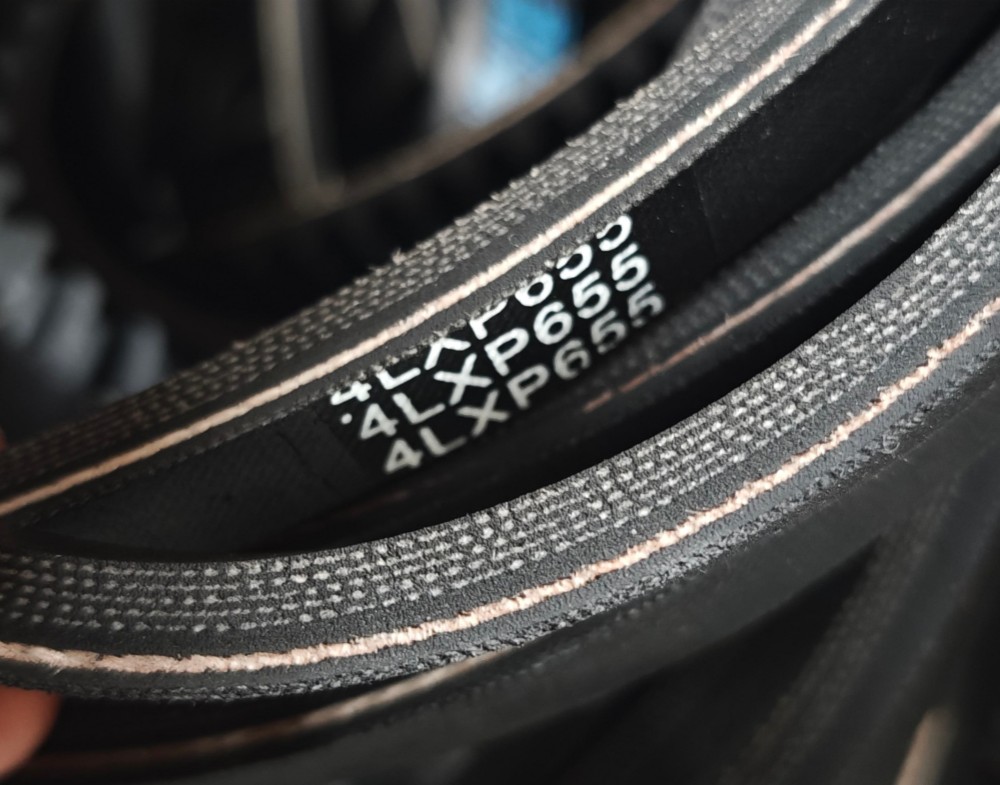
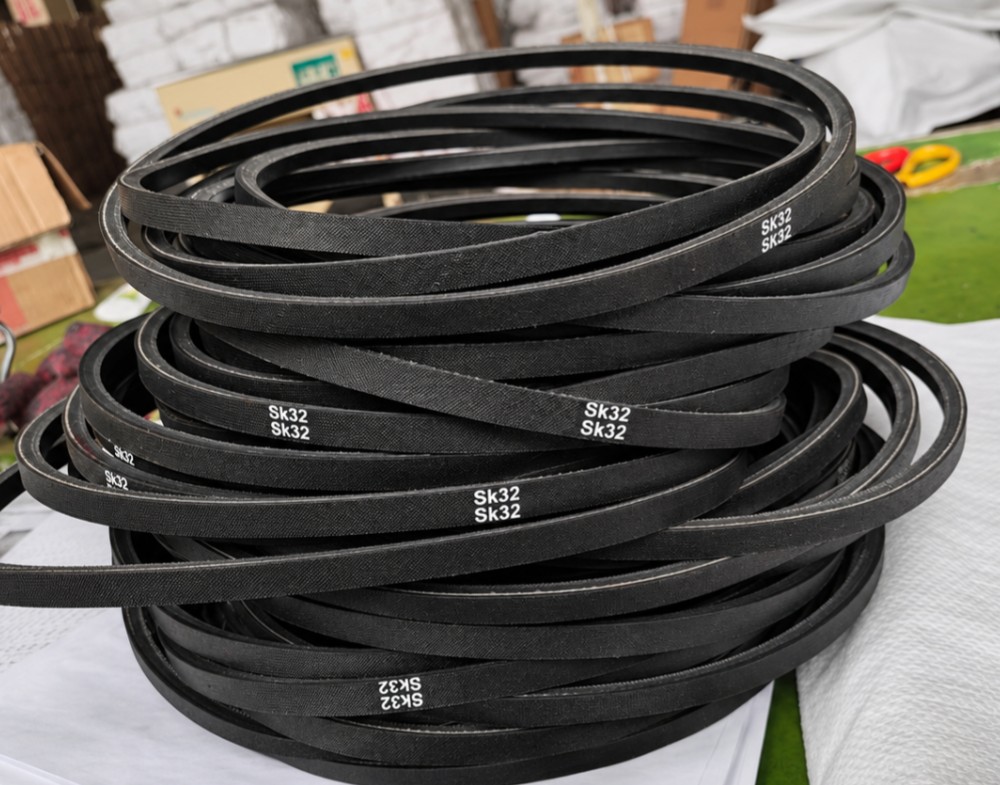
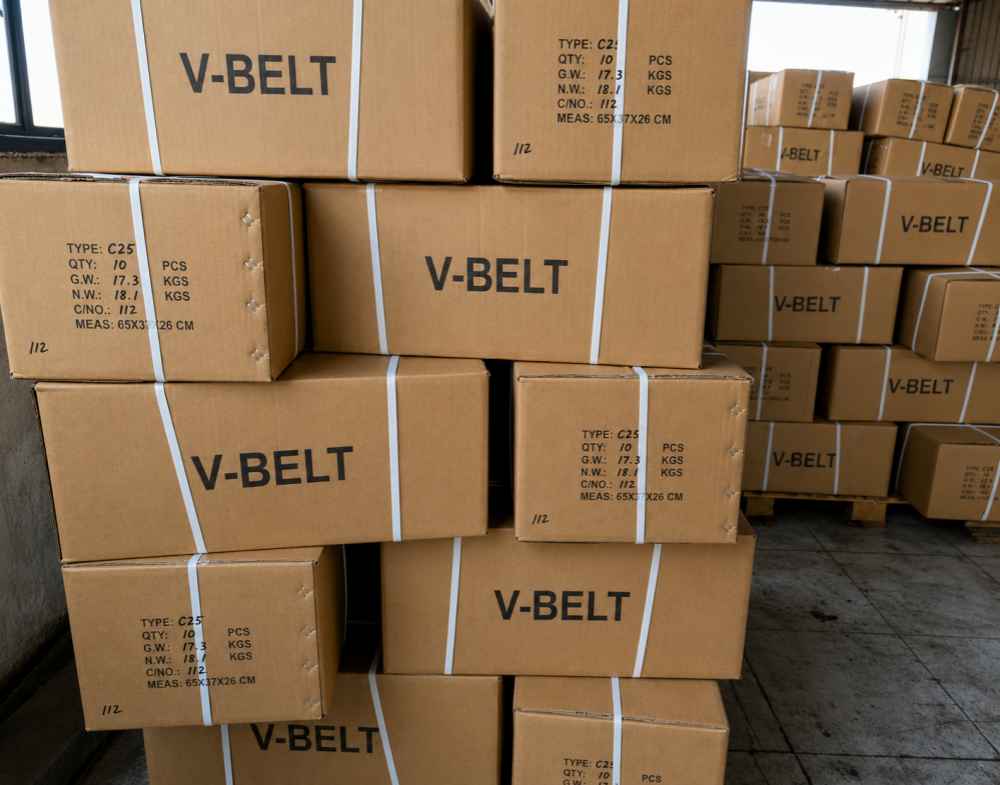
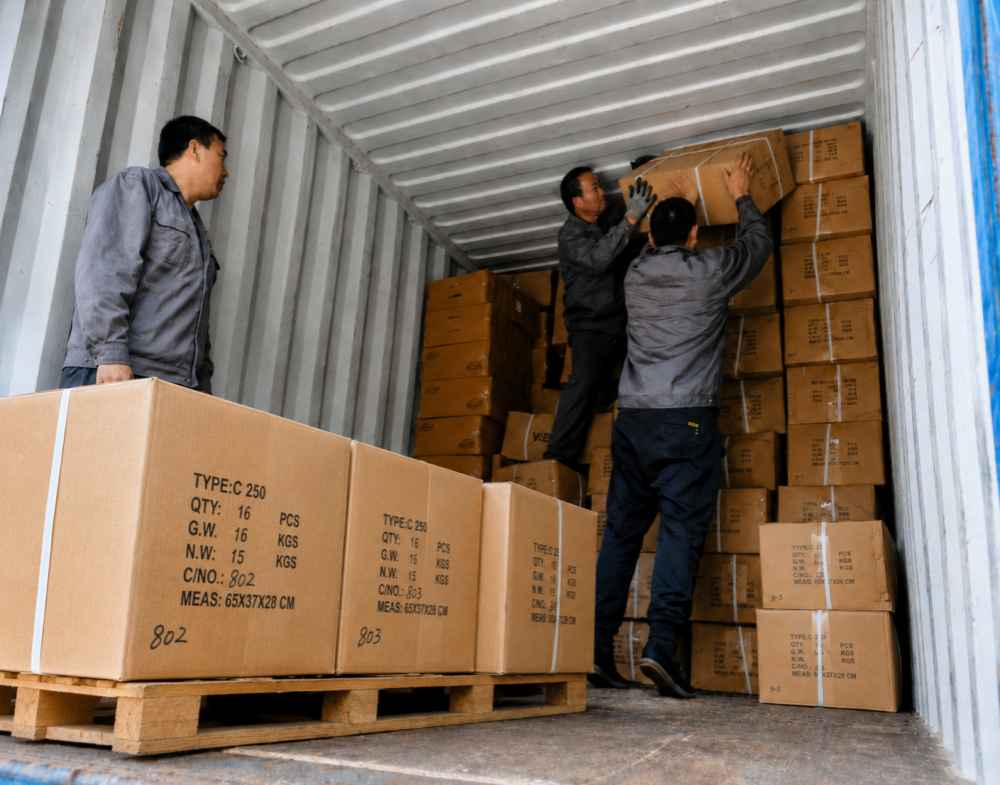
TRANSCO Raw Edge Plain and Laminated V-Belts are available with flexible packaging, belt marking and shipping options for industrial distributors, OEM equipment manufacturers and replacement belt buyers.
We arrange suitable packaging to protect belts from unnecessary deformation, contamination and handling damage during transportation. Packaging methods, belt markings and shipping requirements are confirmed according to the purchase order before mass production. |
|
|
|
|
|
Custom Raw Edge V-Belt Manufacturing
TRANSCO provides OEM and custom raw edge V-belt manufacturing for industrial buyers, distributors, automotive aftermarket suppliers and machinery manufacturers. We supply standard designs and custom-length raw edge V-belts based on confirmed drawings, belt markings and compatible pulley requirements.
Construction Customization: We manufacture Raw Edge Plain and Raw Edge Laminated constructions, including selected fabric-reinforced non-cogged belts. The laminated lower reinforcement is engineered for the specified stability, flex-fatigue and friction requirements rather than presented as an automatic upgrade to all Plain belts.
Rubber Compound Selection: Our CR and EPDM rubber formulations are selected for wear, thermal exposure, ozone and ageing resistance, or specified oil-contact requirements where applicable. We can review a custom rubber V-belt formulation or an EPDM raw edge V-belt for a defined engine accessory or industrial application.
Tensile Cord & Fiber Reinforcement: We support polyester and aramid tensile cords and optional aramid-fiber reinforcement in selected rubber compounds. We determine the material combination according to load, elongation tolerance, bending flexibility and manufacturing feasibility.
Belt Dimensions & Section Options: We manufacture listed V-belt sections and custom lengths according to the confirmed cross section, specified length reference and final drawings. Belt section, width, thickness and length tolerances must be verified before production.
OEM, Drawing & Sample-Based Manufacturing: Our OEM V-belt manufacturing from drawings, samples and part numbers supports replacement and custom projects. We inspect the actual belt geometry and construction before proposing a suitable substitute.
Material combinations, dimensional tolerances and special inspection requirements are confirmed against the final order specification. Depending on the enquiry, we can support a China automotive V-belt factory or industrial belt OEM manufacturing purchase process, including wholesale quantities and drawing-based technical review. Standard private-label marking or packaging requests are assessed with the commercial order.
Frequently Asked Questions
If you are choosing a heat-resistant V-belt, identifying a truck alternator replacement or trying to reduce V-belt squealing, please share the actual drive conditions. We can discuss the likely requirements and verify the belt rather than promising a universal fix.